Showing posts with label realistic fiction. Show all posts

Sunday, December 5, 2021

Inclusive Lit: When Aiden Became a Brother

  When Aidan Became a Brother


A Review by Amanda Kendall

Bibliography:
Lukoff, Kyle. 2019. When Aidan Became a Brother. Ill. by Kaylani Juanita. New York: Lee & Low Books. ISBN 1620148374
 
Plot Summary:
As a young child, Aiden hated the sound of his name and the clothes that he wore. It was more than being a different kind of girl, Aiden didn't feel like a girl at all. He was a boy. Aiden shared his truth with his parents and together they learned, adjusted, and fixed the parts of Aiden's life that didn't feel true to him. When Aiden's mother becomes pregnant, Aiden wants to be the best big brother but worries that, like him, the baby might feel misunderstood. He sets out to find a name that will "fit this new person no matter who they grew up to be" (Lukoff 2019).  He practices reading to the baby. He paints the baby's room with his father. But no matter what he does, he can't shake his worry. Aiden finally talks to his mother. She reassures him that mistakes might be made, but mistakes can be fixed and that the best way to be a big brother is "to love someone for exactly who they are" (Lukoff, 2019).

Critical Analysis:
When Aiden Became a Brother is a beautiful story of acceptance, love, and family. Lukoff writes with care and love, as he tells Aiden's story and explores Aiden's worries about becoming a big brother. The text is straightforward and clear from the beginning, explaining how Aiden did not feel like a girl, but rather "another kind of boy" (Lukoff 2019) and how his family "learned a lot from other families with transgender kids" (Lukoff 2019). As the story continues, Lukoff shows how Aiden's anxiety about the upcoming baby is heavily impacted by the gender stereotypes in the world. The reader sees how gender assumptions and questions make him uncomfortable and how his parents navigate this situations to make Aiden feel at ease. Lukoff uses Aiden's parents as a positive example of how to change the narrative of the dominant culture an counter gender bias. When asked if she is having a boy or a girl, Aiden's mother responds that she is "having a baby" (Lukoff 2019). Aiden and his family show how focusing on the person, rather than a gender, and loving someone for who they are is the most important thing we can do. 

Kaylani Juanita's busy and vibrant illustrations pair perfectly with the text. Each double page spread captures Aiden's emotional journey. Juanita's facial expressions of the characters convey a range of strong emotions from anger, pride, and worry to unconditional love and acceptance. The details on each page show impeccable attention to detail and expand on the text. This is particularly true on the pages that show Aiden's first room and his second room. The first room has broken princess items on the floor and drawings of nature on the easel and notebook paper. The second room is filled with plants and nods to nature and the dress Aiden's mother was holding on the first page is now being used as a flag on a walking stick. Several items remain the same, like the fluffy chair and white rabbit, but many items have been replaced or repurposed to belong in Aiden's new space. Nature continues as a theme throughout the illustrations. For example on the page where Aiden is trying to find possible baby names, he is looking for something to "fit the new person no matter who they grow up to be" (Lukoff 2019), so he looks to nature for inspiration coming up with names like moss, rain, river, forest, and sky. Many pages are filled with text and art blending the words perfectly in the background or within the images leaving very little white space throughout the book. This format weaves the text with the pictures, using both mediums and the complete page to tell Aiden's story. Each digitally rendered illustration beautifully captures the mood and message of Lukoff's words and Aiden's journey.
 
Lukoff and Juanita have created a book that celebrates families, love, and the beautify of being true to yourself. Lukoff's note to readers at the back of the book explains how Aiden's story connects with everyone whether it's through the anxiety of becoming an older sibling or feeling like you don't belong. Void of stereotypes and gender assumptions, When Aiden Becomes a Big Brother proves how important and necessary books that represent the LGBTQ+ community are for ALL readers.

Review Excerpts & Awards: 
 
HORN BOOK GUIDE (Fall 2019) "Brown-skinned (possibly biracial) Aidan, who's transgender, knows how it feels to be misunderstood, so he wants to get things right for his new sibling. Lukoff's straightforward approach to Aidan's gender transition rings with authenticity, and he puts the child-centered story ahead of message. Celebrating the family's close, affirming relationship, Juanita's vibrant digital illustrations take cues from the text, which models how to avoid the male/female binary."
 
KIRKUS REVIEWS (April 1, 2019) "Lukoff breaks away from binary language and stereotypical gender roles, highlighting within the text and in an author’s note that there is more than one way to be a person of any gender. The hopeful message at the end emphasizes love and the importance of staying open to learning. Joyful and affirming, Aidan’s story is the first of its kind among books for welcoming a new baby."
  •  Stonewall Book Award, 2020

 Curricular Connections/Books for Further Reading:

  • Brown, Peter. Fred Gets Dressed. 0316200646
  • Herthel, Jessica. I Am Jazz. 0803741073
  • Love, Jessica. Julian is a Mermaid. 0763690457
  • Lukoff, Kyle. Call Me Max. 147886897X
  • Pearlman, Robb. Pink is for Boys. 0762462477
  • Thorn, Theresa. It Feels Good to be Yourself: A Book About Gender Identity. 1250302951

Monday, November 15, 2021

Asian Pacific American Lit: Home Is In Between


 Home Is In Between

Home Is in Between

A Review by Amanda Kendall

Bibliography:
Perkins, Mitali. 2021. Home is in Between. Ill. by Lavanya Naidu. New York: Farrar Straus Giroux. ISBN 0374303673
 
Plot Summary:
Shanti moves from the "warm monsoon rains" (Perkins 2021) of India to a "town with cold rain" (Perkins 2021) in the United States. Shanti finds her new apartment still feels like her old village but everything outside of that is very strange and new. As she starts school, makes friends, and learns the town she finds herself going back and forth. At home she learns to Kathak with her Ma and learns Bangla letters with Baba. Out of the house she goes to ballet and laughs at Hollywood movies with her friends. Her parents hold tight to the village and her friends show her the town. Pretty soon, Shanti is exhausted from bouncing back and forth between to cultures and needs to rest. She wakes up ready to embrace her bi-cultural life find her home is right there in the in between.

Critical Analysis:
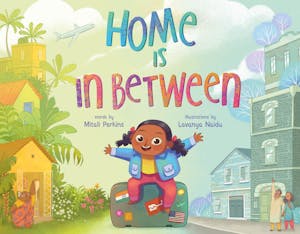
Perkins and Naidu have created a beautifully authentic celebration of growing up as a first generation immigrant in the United States. Perkins skillfully contrasts Shanti's two worlds on every double page spread. From watching Bollywood films with her family to laughing at Hollywood movies with her friends and learning to dance Kathak with her Ma to visiting a ballet class with Tonya, Shanti is constantly immersed in both worlds everyday. Each double page spread shows Shanti experiencing similar things but in different ways. For example, Baba teaches Shanti Bangla letters one one page and then Shanti reads The Little Engine that Could to Baba in English on the page that follows. The structure of the text along with the repetition of the lines "back and forth she ran....again and again. In between" (Perkins 2021) emphasize how Shanti switches from one culture to another as she grows up in both at the same time and how exhausting this back and forth can be. Shanti is finally able to find peace when she realizes that she is from the in between or "the space between cultures" - equally part of both.

Naidu's illustrations are vibrant and almost cartoon like in design. She fully captures the two cultures that make up Shanti's life from the very beginning. The village on the first page is lush and filled with green foliage, while the illustration of the town that follows is rainy and grey. The vibrancy of the village not only captures the authentic foliage and landscape of India but mirrors Shant's feelings toward the two places. The town is initially shown as rainy and grey, unwelcoming, and difficult to understand, but as Shanti finds her place in her new life the town warms up to become as vibrant as her home in the village. In the end, both places are filled with life and color and prove to be an important part of Shanti's identity.
 
Naidu's skillfully uses facial expressions throughout the book to capture character emotions and expand on the text. For example, when Ma and Shanti are in the restaurant, you see Shanti looking around the corner curiously while Ma looks troubled reading the menu.  A few pages later, Ma is checking out at the store while other customers are seen scowling and checking their watch. Shanti is scowling right back. In these little moments a picture is worth a thousand words, capturing Shanti's joy, pain, bewilderment, exhaustion and everything in between. Illustrations range from full page spreads to square box vignettes that showcase Shanti's experiences in both worlds, often with Shanti walking back and forth between the pages. Each illustration is carefully laid out to emphasize the back and forth of Shanti's life as she code switches between her two worlds. 
 
Cultural markers fill the text and illustration on every page. The characters are authentically represented in skin tone, dress, and hairstyle. Stereotypes are avoided entirely, with characters that are proudly showing off their culture on each page. Perkins includes many cultural references including luchi, a Bengali puffed deep fried bread and frequent mentions of Bangla, the Bengali language. Shanti watches Bollyhood films, celebrates Holi, and plays the harmonium. The entire book from cover to cover is a celebration of the combining of American and Indian culture within Shanti. In the author's note, Perkins explains her own experiences growing up as a first generation immigrant and her desire to understand "American manners, slant, trends and rituals - the "code" at school" while also "trying to stay fluent in traditional Benglai culture and language - the "code" of home" (Perkins 2021). She goes on to explain how this code switching has become her greatest superpower and offers hope to those immigrants in similar situations. The book wraps up with a helpful glossary of terms and a pronunciation guide for readers. 
 
With detailed expressive pictures and thoughtfully written text, Home is In Between shows readers the beauty and power of being a first generation immigrant, proof that one can have their American identify while holding on to their cultural identity in the perfectly balanced in between.


Review Excerpts & Awards: 
 
BOOKLIST (June 1, 2021) "Reflecting the experiences of Perkins and many other immigrant children, this heartfelt picture book records the push/pull of remembering the old ways while learning the new ones. Lively and specific in its references, the writing sets up cultural dichotomies that work particularly well in expressive, richly colored artwork by Naidu, an Indian animator and illustrator. By shining a light on one girl’s story, this vibrant picture book illuminates the experience of many immigrant children"
 
PUBLISHER'S WEEKLY (January 4, 2021) "Animation-style characters by Naidu (Susie Will Not Speak) reflect emotion clearly, while straightforward writing by Perkins (Between Us and Abuela) shows how Shanti learns to appreciate aspects of her new life while keeping people and elements from her old one close to her heart.

 Curricular Connections:

  • Shanti learns many new things throughout the book. Have students learn something new. From learning a new recipe to learning a new trick on the bike encourage students to try something new to broaden their experiences.
  • Shanti's identity continues to grow and change throughout the book. Have students make an identity web about themselves.

Saturday, October 30, 2021

Native American Lit: Birdsong

Birdsong

A Review by Amanda Kendall
Birdsong (picture book) - Wikipedia

Bibliography:
Flett, Julie. 2019. Birdsong. Vancouver: Greystone Books. ISBN 1771644737
 
Plot Summary:
In the span of a year, Katherena's life changes dramatically. In the spring, she moves with her mother from a house by the sea to a new home in the country. In the summer, her mother encourages her to go visit their older neighbor, Agnes whom Katherena instantly bonds with over a love of art and creating. In the fall, Katherena visits Agnes again and again, each visit bringing the two friends closer. In winter, Agnes gets sick and Katherena brings her salmon soup. When spring rolls around again, Katharena visits her friend to bring the beauty of nature to Agnes's bedroom.The two talk about art and enjoy the silence of each other's company. When Katherena leaves she reflects on how privileged she is to have Agnes as a friend.

Critical Analysis:
Julie Flett's talent for storytelling and creating are exquisitely showcased in Birdsong. A Cree-Metis author and illustrator, Flett shares her cultural background throughout the picture book. The thoughtful text sets a slower pace for this read and creates a reflective mood throughout the story. Simple sentences are expertly crafted to paint images in the readers mind and evoke emotion. For example in the line "It's a murky spring morning as we pack up the last of our belongings and leave our little home in the city by the sea" (Flett 2019) the words are simple enough, but the imagery is strong and the sadness of the character palatable. Strong descriptive words and meaningful dialogue move the story along at just the right pace showing the passing of time in both the everyday and the friendships developed over time.
 
Flett's pastel and pencil illustrations are soft and emotional. The natural colors and textures compliment the mood of the text. The earthy tones match the story's seasonal structure and bring a sense of calm and order to the story. In addition to the use of natural tones, Flett includes other authentic cultural markers throughout the text. Her characters are authentically represented in skin tone and show the everyday life of someone sharing her culture. The illustrations have a strong focus on nature and the natural order that nature brings to the world. The color tones, textures, and soft sometimes blurry lines, create soothing images. Flett focuses on birds throughout the illustrations, including a different species on almost every page. At times, the birds are the focus of the illustration as when the geese fly south for winter and other times they are subtly included sitting in a tree outside a window. The story and birds come full circle in the end when Katherena's drawings of each bird are put up around Agnes's room. Beautifully crafted, each illustration enhances the story and impresses the importance of connection to nature and creativity.
 
Cultural markers of the Cree-Metis people can be found flawlessly woven into the text. Authentic names are used for characters like Katharena and her dog, Ôhô which means owl in Cree. Katharena also tells Agnes about the Cree seasons, explaining that the current month "is called pimihâwîpisim - the migrating moon" (Flett, 2019). Katharena sleds on a toboggan and makes salmon soup to take to her friend. These small details help paint a beautiful authentic picture of a young Cree girl who has found a true friend in her neighbor.
 
Ultimately, Birdsong is a celebration of friendship. The friendship that develops between Katharena and Agnes shows how friendships can develop through shared interests regardless of age. It is the art and act of creating things that brings them together. Strong themes of nature, friendship, the passage of time, and finding beauty in the small moments all make this book a charming book about life.

Review Excerpts & Awards: 

PUBLISHER'S WEEKLY (September 30, 2019) "Cycling from spring to spring, Flett's subtle, sensitive story delicately traces filaments of growth and loss through intergenerational friendship, art making, and changing moons and seasons. Cree-Métis words (defined in a small glossary) add an intimate layer of identity to the child’s lustrous narration, which shines against the spare beauty of rich illustrations by Flett (who is Cree-Métis)"
 
KIRKUS REVIEWS (July 1, 2019) "Flett’s simple story explores the difficulties of moving but also shows young readers how new friends can sometimes ease them; that this friendship is an intergenerational one between fellow artists is an especially sweet touch. Flett (Cree/Métis) employs her characteristically minimalist style, placing Katherena against flat expanses of greensward that changes with the seasons, birds wheeling above in silhouette. Katherena and her mom both have brown skin and straight, black hair; Agnes has brown skin as well, but she does not speak Cree. Emotionally stunning.
  • Winner of the TD Canadian Children's Literature Award, 2020
  • American Indian Youth Literature Honor Title, 2020
  • A Boston Globe - Horn Book Honor Book
  • Best Book of the Year: Publisher's Weekly, School Library Journal, Kirkus, Horn Book, Quill & Quire, Globe and Mail

 Curricular Connections:

  • Seasons are an important element of the book. Have students create a collage of their favorite season using a variety of materials and textures.
  • Friendship is an important theme in Birdsong. Discuss what makes a good friend using examples from the book and create an anchor chart for reference.
  • Moving to a new place is difficult. Pair this text with Evelyn Del Rey is Moving Away by Meg Medina to explore how friendships may change and develop during this transitional time. 
  • Create a character change visual using a circle divided into 4 equal parts to show how Katherena changes throughout the year, season by season.

Native American Lit: Rez Dogs

 Rez Dogs

A Review by Amanda Kendall
 Rez Dogs: Bruchac, Joseph: 9780593326213: Amazon.com: Books

Bibliography:
Bruchac, Joseph. 2021. Rez Dogs. New York: Dial Books for Young Readers. ISBN 0593326210
 
Plot Summary:
Malian is visiting her grandparents on the Wabanaki reservation when the world shuts down due to the COVID-19 global pandemic. With all travel halted, the reservation goes into lock down and Malian is unable to return to her parents in the city. She remains on the reservation helping to care for her grandparents and attending online school. Unexpectedly, a dog shows up and makes himself a part of the family. Malsum, a rez dog, has shown up at just the right time. He is there to protect and support the family. Together Malian and Malsum navigate life during the pandemic. Malian's grandparents share stories of their people and their history.  She makes connections between her reality and her people's experiences in the past. She embraces her heritage more with each story and finds the strength she needs to get through the pandemic is deeply rooted in her family, dog, and history.
 
Critical Analysis:
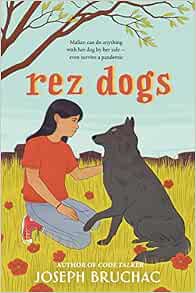
Rez Dogs is uniquely relevant to the lives of children and young adults today. Based on the history we are all living, this special novel will connect with many. Rez Dogs beautifully captures the experiences of many living through the COVID-19 pandemic. Bruchac uses free verse poetry to make Malian's story accessible to young readers. Her thoughts and emotions come across clearly through the poetry allowing the reader to feel her fear and hope every step of the way. Although the novel is set on the Wabanaki reservation, the experience of being stuck at home for months at a time, unable to see friends and participate in regularly scheduled life is universal for kids who are living through the pandemic. However, the reservation is a lovely backdrop for Malian's story to unfold, giving readers an look at how Native Americans live on a reservation today. As Malian explains, it's not the same as being in the big city where she lives with her parents, but just like the rez dogs, the reservation is a part of her and "a rez dog knows where it needs to be" (Bruchac 2021).
 
The text reads quickly, telling the story in a direct yet gentle way. Hard historical are covered but not lingered upon. For example, Grampa Roy reflects on his time in "Indian school" saying "every knuckle on both my hands got broken one time or another from being hit with that heavy ruler" (Bruchac 2021). And Grandma Frances explains how "it was still common for the Indian Health Services to make it so that Indian women could not give birth to any more children after they had had two or three...they'd done - an operation to prevent her from ever having more kids" (Bruchac 2021). In both these instances, Bruchac does a masterful job sharing historical truths with sensitivity and in age appropriate ways. This window into the history of Native Americans is expertly woven into the story. The details are included not to teach the outsider, but rather to show Malian the strength that her people have shown time and time again in the face of adversity, and getting through a global pandemic is another obstacle to overcome.
 
Family and stories are strong themes throughout the novel. Because Malian is locked down with her grandparents, the reader gets a front row seat to the beautiful intergenerational relationship between these characters. Her grandparents are there to protect her, and she is there to protect them. In addition, Malian's grandparents, both master storytellers share stories with her often. They use these stories to teach, guide, and give her strength. Even if she's heard the story before she loves to hear them again because "every storyteller had their own way of seeing a story without really changing it" (Bruchac 2021). At the end of the novel, Malian's teacher assigns an end of the year presentation to "tell your story." After months with her grandparents, Malian is uses her own storytelling skills to present a powerful presentation about her heritage, her family, and the  importance of taking care of each other and the land. 
 
Bruchac's use of cultural markers throughout the text prove why he is one of the most authentic, skilled, and trusted Native American writers for young people. By using authentic names, descriptions, and dialogue, Bruchac's characters are authentic in every way. Malian frequently uses the old Wabanaki language throughout the novel. For example, she says, "Kwai, kwai, nidoba. Hello, hello, my friend" (Bruchac 2021) when she first meets Malsum. Foods and cultural traditions are also included in the story. For example, her grandmother makes fry bread, and they leave a warm piece of bread "under a cedar tree to share it with the Manogies, the little people who are the guardians of the natural world" (Bruchac 2021). The story is saturated with cultural markers because they are so naturally a part of the setting and the characters.  

Review Excerpts & Awards: 

PUBLISHERS WEEKLY (May 31, 2021) " Employing the third-person perspective, Bruchac intricately interweaves past and present stories, displaying how Native mistreatment has been cyclical with a deft touch in this rewarding intergenerational narrative."
 
BOOKLIST (April 15, 2021) "Episodic in structure, it captures the family’s daily lives and shares the grandparents’ traditional stories, ensuring that a connection remains between them and the natural world. Readers also learn about injustices visited on Native peoples and hear Malian’s white teacher’s declaration that “we need to learn more of each other’s stories.” With this gentle book, Bruchac offers children another story to expand their worlds and hearts."

 Curricular Connections: 

  • Invite students to create their own "tell their story" presentation just like Malian's end of the year project.
  • Helping others is another important theme in Rez Dogs. Malian's choices while she is staying with her grandparents are always guided by her desire to protect and help her grandparents. Have students make a list of ways they can help and protect their families and others during the pandemic. (Examples: washing hands frequently, staying home when sick, etc.)

More Books by Joseph Bruchac:

  • Bruchac, Joseph. Code Talker: A Novel About the Navajo Marines of World War Two. 0803729219
  • Bruchac, Joseph. Peacemaker. 1984815377
  • Bruchac, Joseph. Skeleton Man. 0060290757
  • Bruchac, Joseph. Two Roads. 0735228868
  • Bruchac, Joseph. Talking Leaves. 0142422983  

Monday, October 11, 2021

Latinx Lit: Carmela Full of Wishes

  Carmela Full of Wishes

A Review by Amanda Kendall
Carmela Full of Wishes by Matt de la Peña, Christian Robinson, Hardcover |  Barnes & Noble®
 
Bibliography:
de la Peña, Matt. 2018. Carmela Full of Wishes. Ill. by Christian Robinson. New York: G.P. Putnan's Sons. 9780399549045
 
Plot Summary:
Carmela starts her birthday with candles on her pancakes and the knowledge that she is finally old enough to go with her big brother. The two walk through their thriving community together until they arrive at the local laundromat. There, Carmela finds a lone dandelion puff on the sidewalk. She picks the dandelion and carries it through her community.  From a vending machine that has anything you could desire to a fancy bed for her mother and proper paperwork for her father, Carmela imagines all the wishes she would like to make but is unable to decide how to best use her one dandelion. When Carmela crashes on her scooter, drops the dandelion, and loses her wish that her brother comes to her rescue. He takes her to the beach with a field of dandelion puffs, helping her hold on to hope, and see "the sky is full of wishes" (de la Peña 2018).

Critical Analysis:
Matt de la Peña and Christian Robinson prove to be master storytellers with each collaboration. Carmela Full of Wishes is no exception. Peña's text is elegant and precise. His word choice turns each page into a celebration for the senses. His words trigger the sights, sounds, and smells of Carmela's neighborhood for the reader. Her bracelets are "jingling and jangling" (de la Peña 2018), the air smells of "marigolds and overturned earth and fresh manure" (de la Peña 2018), carts are rattling, and brothers are giving annoyed looks. All of these realistic details are woven into the story repetitiously, creating a beautiful narrative that connects each page to the last. As Carmela and her brother journey through town, Peña repeats the sounds of Carmela's bracelets jingling and the word imagining as she thinks of all her wishing possibilities.  Peña also uses repetition throughout the text to create continuity within the story. His dialogue follows this recipe for success and captures a true sibling relationship of both annoyance and support from beginning to end. All in all, Peña's creative choices make Carmela Full of Wishes a joy to read aloud. 
 
Robinson's illustrations compliment and enhance the text every step of the way. His signature collage and paint illustrations are filled with vibrant colors and well used white space. Some pages exude happiness with bold, bright backgrounds while other pages are left more sparse allowing the illustrations to match the feelings of Carmela throughout the story. The characters authentically represent the Hispanic community in the story and include people of all ages and even an expectant mother. They reflect real life and a real community. Cultural markers of the Latin community can be found in many of the backgrounds of the illustrations. For example a flower sign reads "Rosas Flores" and the corn food cart is located right outside the panadería. One of the most eye catching cultural markers is the illustrations of Carmela's wishes. Each wish is showcased in the style of a papel picado, a traditional style of Mexican folk art that involves cutting paper to create intricate designs. Robinson expertly illustrates Carmela's wish coming true within the paper flags design filling the page with unmistakable and well designed cultural reference. 
 
Peña and Robinson's collaboration shows an authentic experience in the Latinx community. Skillfully executed, the picture book has many layers to be explored and understood.  Subtly including themes of labor and immigration, some readers may miss these cultural markers while others may feel seen for the first time, a powerful mirror for these children. For others, it opens a window to the authentic experiences of many and provides an opportunity for important conversations. The book opens with Carmela scooting past the workers in field and the green houses. She mentions walking past the home improvement store where her dad used to wait for work. Her wish for her mother is to sleep in one of "fancy hotel beds" she made. Each one of these examples is Peña's quite way of showcasing the many labor experiences of his community. The theme of immigration is gently touched upon when Carmela imagines her dad "getting his papers fixed so he could finally he home" (de la Peña 2018). The final scene at the beach with the sky filled with dandelion seeds ends the story on a positive and hopeful note. There are always more wishes. There is a "sky full of wishes" (de la Peña 2018). You don't have to pick just one.

Review Excerpts & Awards: 

PUBLISHER'S WEEKLY (July 30, 2018) "The award-winning team behind Last Stop on Market Street portrays Carmela's Spanish-speaking community as a vibrant place of possibility, and Robinson's acrylic-and-cutout spreads introduce readers to street vendors, workers in the fields, and sweeping views of the sea. Sensitively conceived and exuberantly executed, Carmela's story shines."
 
KIRKUS REVIEWS (September 1, 2018) "This second de la Peña–Robinson collaboration after Last Stop on Market Street is no less powerful and beautiful. It touches on immigration, class, and loss without belaboring each. And it’s full of rich details, sharp and restrained writing, and acrylic paintings that look textured enough to rise off the page. In one brilliant sequence, Mexican papel picado depicts what Carmela imagines, ending with “her dad getting his papers fixed so he could finally be home” and a cutout of a kneeling father embracing his daughter. It’s a bracing page, the best in the book, and just as sublime as the text. It’s another near-perfect slice of life from a duo that has found a way to spotlight underrepresented children without forgetting that they are children first."
  • Publishers Weekly Most Anticipated Children’s Book – Fall 2018
  • Publishers Weekly Best Book of 2018
  • Kirkus Reviews Best Picture Book of 2018
  • Boston Globe Best Children’s Book of 2018

 Curricular Connections:

  • Carmela thinks hard about her wish. She imagines things like a vending machine that has whatever she wants but also imagines wishes that would improve the lives of the people around her. Like Carmela, have students hold on to hope and make a list of wishes they would like to see come true. 
  • Create a dandelion puff painting using white tempra paint and empty toilet paper rolls. Click here for step by step directions on using toilet paper rolls to create the dandelions.
  • Carmela's birthday is special because of the experience she shares with her brother. Use Carmela Full of Wishes as a mentor text to spark ideas in writing. Have students write about a special memory with a loved one.
  • Create your own papel picado project. Step by step directions can be found here.

Sunday, September 26, 2021

African-American Lit: Ways to Make Sunshine

Ways to Make Sunshine

A Review by Amanda Kendall


Bibliography:
Watson, Renee. 2020. Ways to Make Sunshine. Ill. by Nina Mata. New York: Bloomsbury Children's Books. ISBN 1547606657
 
Plot Summary:
Given a name to live up to is a big responsibility, especially when your name means "king." But Ryan Hart is up for the challenge. She is determined to be a leader no matter what life throws at her. The story begins with Ryan's parents offering ice cream before dinner, a sure sign that bad news is coming. After Ryan's father lost his job with the post office months prior, he accepted a new job making less money. So, the family will have to downsize which means selling a car, moving to a smaller house, and cutting back on expenses. The story continues with Ryan enduring one spontaneous disaster after another including a failure at church, a contest to prove her loyalty to a friend, and a struggle to showcase her gift for cooking at the school's talent show. As Ryan copes with the changes and challenges in her daily life she finds sunshine in creating new recipes, spending time with family and friends, and finding the positive in every situation. 
 
Critical Analysis:
From the very first page, Ryan Hart's first person narrative welcomes readers into her world. She is smart, spunky, and determined to live up to her name. The novel unfolds as a series of short episodes where inevitably something goes terribly wrong for Ryan. From forgetting her lines at the Easter service (again!) to ruining her hair in the pool at a sleepover, Ryan finds herself in one unfortunate situation after another. Yet each time she pulls through with grace, humility, and positivity. Watson's writing style is engaging and clear. The short chapters read quickly keeping readers engaged in the text and eager to read one more chapter.  The grayscale illustrations are a window into Ryan's world and add to the authenticity of the text throughout the novel. One illustration shows Ryan's grandmother straightening her hair, honoring the cultural tradition of family and the importance of hair in the African-American culture. Another illustration shows Ryan sleeping in her head scarf to protect her hair. Yet another illustration beautifully captures the love of the Hart family with them all dancing and cooking together.
 
Ryan's story focuses on the everyday ups and downs of childhood including spats with her older brother, moving to a new (old) house, and being paranoid that she's lost her best friend. Watson's story has great universal appeal, but also captures the life of a 10 year old Black girl living in Portland with her family.  The main characters are richly developed, free of stereotypes, and show all sides of the human experience. One of Ryan's greatest gifts is compassion. She frequently shows empathy to the people around her, but it doesn't keep her from succumbing to jealousy at a friend's house and getting into a swimming contest with her nemesis. She's a real character, but not perfect and learning through her experiences alongside the reader.
 
Ryan's experiences also reflect distinct cultural experiences of a Black girl. Ryan struggles to see herself with her natural hair as beautiful and loves when her grandmother spends hours straightening it. But when she is pushed to her limits at her friend's sleepover, she jumps into the pool and consequently ruins her hair. As soon as it gets wet, her straight hair is gone and her "puffy" (Watson 2020) hair is back. She's upset and embarrassed so she runs off. But in true Ryan fashion, she finds her confidence, pulls her hair into "a big, big Afro puff" (Watson 2020), and rejoins the group saying she is trying to be the "beautiful person my Grandma says I am" (Watson 2020). This theme of beauty standards that oppress and make Ryan feel less than are one of the many cultural markers gently woven into this story.

Other important themes that reflect the African-American experience throughout the story are the effects of unemployment, loyalty and obligation to family, and the power of friendship. The effects of unemployment are threaded throughout the story. When Ryan is at the grocery story with her mother she doesn't ask for any special ingredients or spices for her recipes. She doesn't say a word when her mother puts the generic brand of cereal into the shopping cart and when Ryan burns the chicken, her mom quietly mumbles about the cost of the chicken, but tells Ryan it will be alright. For Ryan's family the loss of income has direct effects on their daily lives and that shows throughout the story, but it is always shown in a way that shows the family's love, respect, and loyalty to each other. Another important theme is friendship. Ryan has amazing friends that stick by her in every situation. When Ryan's hair is ruined in the pool and she runs off, only her friend, Amanda, can make her feel better. "Then Amanda comes to the floor. She doesn't knock or ask me if I'm okay. She just sits on the floor. I know it's her because she is the only one that when I'm upset, I don't want to talk about it" (Watson 2020). It is grandmother's advice that kindness is what makes a person beautiful and Amanda's unwavering support that gives her the strength to return to the party and join the fun. Throughout the novel, Ryan's friends and family are the foundation for her sunshine. Ways to Make Sunshine shows how positivity, kindness, and support from family and friends can make all the difference. Ryan continually lives up to her name by leading with kindness, compassion and heart for herself, her family, and her friends.
 

Review Excerpts & Awards:
 
BOOKLIST (March 15, 2020) "More than a window into the everyday experiences of children of color, this ensures that African American girls in particular feel seen."

SCHOOL LIBRARY JOURNAL (March 20, 2020) "From Easter speeches to African American hair care, this book will give those whose lives are like Ryan's an opportunity to feel seen. For those whose lives are different, this book provides a clear window into a nuclear family dealing with familiar topics in a unique way."
 
KIRKUS REVIEWS (February 15, 2020) "Each episodic chapter confronts Ryan with a situation; intermittently funny, frustrating, and touching, they should be familiar and accessible to readers, as when Ryan fumbles her Easter speech despite careful practice. Ryan, her family, and friends are black, and Watson continues to bring visibility to both Portland, Oregon, generally and its black community specifically, making another wonderful contribution that allows black readers to see themselves and all readers to find a character they can love. Move over Ramona Quimby, Portland has another neighbor you have to meet!"
  •  Bluebonnet Award Nominee - 2021

 Curricular Connections: 

  • Ryan loves to cook and create new recipes. Encourage students to cook a new recipe at home with family or create their own version of a family favorite by adding or swapping ingredients.
  • Create a keepsake box out of an old shoe box. Encourage students to select 3-4 artifacts that are meaningful to them to put in the box and share. Use the items in the box as inspiration for writing.
  • Make a list of "Ways to Make Sunshine" in your own life and share with the class. 

Saturday, September 11, 2021

International Literature: Cannonball

Cannonball

A Review by Amanda Kendall


Bibliography:
Cotter, Sacsha. 2020. CANNONBALL. Illustrated by Josh Morgan. Naperville, Illinois: Sourcebooks Jabberwocky. ISBN 978-1728217567
 
Plot Summary:
In New Zealand, nothing brings kids greater joy than doing the perfect cannonball in the summer. But perfection is not easily achieved. In CANNONBALL, one young boy seeks out the advice of people around town to elevate his cannonball to legendary status. He attempts to incorporate everyone's well meaning advice from bigger shorts to more height, but he just can't seem to get it right. After a defeating cannonball turned belly-flop, he goes to his Nan who advises him to listen to his heart and find a way to do it his own way. Finding his voice gives him the courage to make the perfect splash!

Critical Analysis:
In an explosion of summer, Cannonball's lively illustrations, rhythmic text, and celebration of individuality make this book an overall crowd-pleaser. Cotter's text is highly interactive. The first person point of view invites the reader to experience the story right along with the protagonist. Pages alternate between those that follow a distinct rhythm and rhyming pattern and others that don't. Awkward at first, this irregularity is critical to the flow of the text and highlights the emotions the characters experiences throughout the story. After every disappointment, the text swings back to a happy,cheerful rhyme encouraging both the boy and the reader not to give up. Cotter's repetitive use of the boy's chant before jumping in the water shows his evolution as a character. While the words remain the same, the voice that he uses to express those words builds along with his confidence. Paired beautifully with the pictures, the final chant begs to be screamed as the boy leaps into the water doing a perfect cannonball his own way!

Morgan's illustrations capture of the joy of summer. His choice of vivid colors and unique texture backgrounds make each page a visual delight. The inclusion of math symbols, tools, numbers, and grid paper background on the first few pages cleverly conveys the complexity of the perfect cannonball and the boy's dedication as he thinks about it from every angle. This attention to detail continues through the variety of illustrations in the book. Some are full page color. Some are a collection of smaller images mashed together. Many pages have a simple white background, focusing the reader's attention on the characters while other full page spreads capture the beauty and vibrancy of New Zealand. The boy's final fabulous cannonball is brilliantly broken into a four panel spread. Following this slow motion cannonball is a magnificent double page SPLASH that requires the reader to turn the book vertically to see it.

Cannonball is a celebration of New Zealand and the Maori people, the indigenous Polynesian people of the New Zealand mainland. The characters are authentic and true. The boy's hair is pulled back in a traditional Maori bun and the necklace he wears is a traditional jade Maori necklace. The design is a manaia or spirit creature which symbolizes a spiritual guardian. Maori words are used throughout the story including a postcard that reads "Nga Mihi" which means greetings for the new year. Manu (meaning bird) and puku (meaning stomach) are both used within the text as well. Cotter even provides a glossary of Moari words and types of dives in the back of the book for the reader. The unique setting of New Zealand is captured in the illustrations in big and small ways. Morgan's illustrations include a wide array of plants and animals found only in New Zealand. The New Zealand Kingfisher bird makes multiple appearances throughout the story with its highly recognizable coloring and markings. The boy is seen sitting in a New Zealand Christmas Tree and red flowers from the Pohutukawa tree along with the yellow kowhai flowers are both a part of the boy's final cannonball ensemble. Lastly tauparapara or chants are used by the Maori people to pass on knowledge. The boy's cannnonball chant is another example of the Maori tradition embedded in the story.
 
Cannonball wins over the reader a little more with each subsequent read. The ideas of being yourself and finding your voice are strong themes and well executed, but it is the vivacious illustrations and sometimes silly but fun text that make this book pure joy to read aloud!

Review Excerpts & Awards:
 
SCHOOL LIBRARY JOURNAL (June 1, 2020) "Along with the expressive images, the story will resonate with those learning how to navigate the emotional minefield of turning a failure into a success."

KIRKUS REVIEWS (May 1, 2020) "This distinctive story of summer fun and growth, set within a culture underrepresented on North American shelves, carries a universal message of listening to one’s own heart and being oneself when the world tries to tell you how and who to be."
  • USBBY Selection, 2021

Curricular Connections: 

  • In CANNONBALL, the boy has a chant he says before each cannonball attempt. Have students write a new chant that inspires them to listen to their voice and gives them the courage to try something new.
  • Have students think about the advice they have been given in the past. Who gave good advice? Who gave poor advice? Discuss how you know if it is good or bad advice? How do you know whose advice to follow?
  • Share the glossary at the back of the book that includes Maori words. Have students research more about New Zealand and the Maori people using online resources.