Showing posts with label chapter book. Show all posts

Saturday, October 30, 2021

Native American Lit: Rez Dogs

 Rez Dogs

A Review by Amanda Kendall
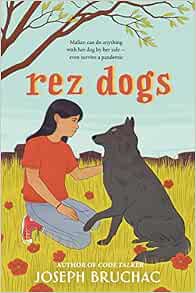
 Rez Dogs: Bruchac, Joseph: 9780593326213: Amazon.com: Books

Bibliography:
Bruchac, Joseph. 2021. Rez Dogs. New York: Dial Books for Young Readers. ISBN 0593326210
 
Plot Summary:
Malian is visiting her grandparents on the Wabanaki reservation when the world shuts down due to the COVID-19 global pandemic. With all travel halted, the reservation goes into lock down and Malian is unable to return to her parents in the city. She remains on the reservation helping to care for her grandparents and attending online school. Unexpectedly, a dog shows up and makes himself a part of the family. Malsum, a rez dog, has shown up at just the right time. He is there to protect and support the family. Together Malian and Malsum navigate life during the pandemic. Malian's grandparents share stories of their people and their history.  She makes connections between her reality and her people's experiences in the past. She embraces her heritage more with each story and finds the strength she needs to get through the pandemic is deeply rooted in her family, dog, and history.
 
Critical Analysis:
Rez Dogs is uniquely relevant to the lives of children and young adults today. Based on the history we are all living, this special novel will connect with many. Rez Dogs beautifully captures the experiences of many living through the COVID-19 pandemic. Bruchac uses free verse poetry to make Malian's story accessible to young readers. Her thoughts and emotions come across clearly through the poetry allowing the reader to feel her fear and hope every step of the way. Although the novel is set on the Wabanaki reservation, the experience of being stuck at home for months at a time, unable to see friends and participate in regularly scheduled life is universal for kids who are living through the pandemic. However, the reservation is a lovely backdrop for Malian's story to unfold, giving readers an look at how Native Americans live on a reservation today. As Malian explains, it's not the same as being in the big city where she lives with her parents, but just like the rez dogs, the reservation is a part of her and "a rez dog knows where it needs to be" (Bruchac 2021).
 
The text reads quickly, telling the story in a direct yet gentle way. Hard historical are covered but not lingered upon. For example, Grampa Roy reflects on his time in "Indian school" saying "every knuckle on both my hands got broken one time or another from being hit with that heavy ruler" (Bruchac 2021). And Grandma Frances explains how "it was still common for the Indian Health Services to make it so that Indian women could not give birth to any more children after they had had two or three...they'd done - an operation to prevent her from ever having more kids" (Bruchac 2021). In both these instances, Bruchac does a masterful job sharing historical truths with sensitivity and in age appropriate ways. This window into the history of Native Americans is expertly woven into the story. The details are included not to teach the outsider, but rather to show Malian the strength that her people have shown time and time again in the face of adversity, and getting through a global pandemic is another obstacle to overcome.
 
Family and stories are strong themes throughout the novel. Because Malian is locked down with her grandparents, the reader gets a front row seat to the beautiful intergenerational relationship between these characters. Her grandparents are there to protect her, and she is there to protect them. In addition, Malian's grandparents, both master storytellers share stories with her often. They use these stories to teach, guide, and give her strength. Even if she's heard the story before she loves to hear them again because "every storyteller had their own way of seeing a story without really changing it" (Bruchac 2021). At the end of the novel, Malian's teacher assigns an end of the year presentation to "tell your story." After months with her grandparents, Malian is uses her own storytelling skills to present a powerful presentation about her heritage, her family, and the  importance of taking care of each other and the land. 
 
Bruchac's use of cultural markers throughout the text prove why he is one of the most authentic, skilled, and trusted Native American writers for young people. By using authentic names, descriptions, and dialogue, Bruchac's characters are authentic in every way. Malian frequently uses the old Wabanaki language throughout the novel. For example, she says, "Kwai, kwai, nidoba. Hello, hello, my friend" (Bruchac 2021) when she first meets Malsum. Foods and cultural traditions are also included in the story. For example, her grandmother makes fry bread, and they leave a warm piece of bread "under a cedar tree to share it with the Manogies, the little people who are the guardians of the natural world" (Bruchac 2021). The story is saturated with cultural markers because they are so naturally a part of the setting and the characters.  

Review Excerpts & Awards: 

PUBLISHERS WEEKLY (May 31, 2021) " Employing the third-person perspective, Bruchac intricately interweaves past and present stories, displaying how Native mistreatment has been cyclical with a deft touch in this rewarding intergenerational narrative."
 
BOOKLIST (April 15, 2021) "Episodic in structure, it captures the family’s daily lives and shares the grandparents’ traditional stories, ensuring that a connection remains between them and the natural world. Readers also learn about injustices visited on Native peoples and hear Malian’s white teacher’s declaration that “we need to learn more of each other’s stories.” With this gentle book, Bruchac offers children another story to expand their worlds and hearts."

 Curricular Connections: 

  • Invite students to create their own "tell their story" presentation just like Malian's end of the year project.
  • Helping others is another important theme in Rez Dogs. Malian's choices while she is staying with her grandparents are always guided by her desire to protect and help her grandparents. Have students make a list of ways they can help and protect their families and others during the pandemic. (Examples: washing hands frequently, staying home when sick, etc.)

More Books by Joseph Bruchac:

  • Bruchac, Joseph. Code Talker: A Novel About the Navajo Marines of World War Two. 0803729219
  • Bruchac, Joseph. Peacemaker. 1984815377
  • Bruchac, Joseph. Skeleton Man. 0060290757
  • Bruchac, Joseph. Two Roads. 0735228868
  • Bruchac, Joseph. Talking Leaves. 0142422983  

Monday, September 27, 2021

African-American Lit: STAMPED (for Kids): Racism, Antiracism, and You

 STAMPED (for Kids): 

Racism, Antiracism, and You
A Review by Amanda Kendall

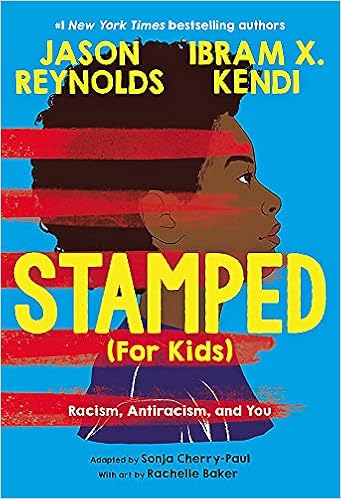
Stamped (For Kids): Racism, Antiracism, and You: Cherry-Paul, Sonja,  Reynolds, Jason, Kendi, Ibram X., Baker, Rachelle: 9780316167581:  Amazon.com: Books
Bibliography:
Cherry-Paul, Sonja. 2021. Stamped (for kids): racism, antiracism, and you . Ill. by Rachelle Baker. New York: Little, Brown and Company. ISBN 0316167584
 
Plot Summary:
Stamped (for Kids): Racism, Antiracism, and You tells the 400+ year story of racism in American one chapter at a time. The book goes all the way back to 1415 when Europeans were conquering lands around the world and enslaving people from those areas. It finishes with a chapter on the Black Lives Matter movement from 2016-2020. Each chapter includes a history of racism during a given time period and mini-biographies of people who have fought against racism along the way. There are also built in stopping points with guiding questions for young readers to reflect on the historical facts presented and connect them to current events and issues in America.

Critical Analysis:
Stamped (for Kids): Racism, Antiracism, and You is a remix of a remix that's written specifically for younger audiences. Cherry-Paul has expertly streamlined and simplified Stamped: Racism, Antiracism, and You by Jason Reynolds. The chapters read quickly and although filled with historical facts and truth, they feel more like a casual conversation with a friend. Cherry-Paul's writing style, tone, and voice make an often difficult subject to broach with kids very accessible. Baker's simple illustrations of the many antiracists throughout history are a powerful addition to the text. Each illustration highlights the powerful voices who made an impact and fought against racism over the years and often showcase some lesser known antiracists like Malcom X, Mahalia Jackson, and Angela Davis to name a few.

The short, chronological chapters focus on specific concepts throughout the book. In chapter 4, "Flawed Founding Fathers" Cherry-Paul writes, "Learning about the history of racism means discovering that some people, even some who you may have considered heroes, were deeply flawed individuals who had racist thoughts and did racist things" (Cherry-Paul, 2021). She goes on to explain how Thomas Jefferson wrote that all men were created equal, but he owned more than 600 enslaved people (Cherry Paul, 2021). Because of this contradiction of ideas verses actions, she helps the reader understand that racist ideas were woven into America's beginnings. In chapter 11, "Racism On-Screen," readers learn how racist ideas have been a part of beloved stories for years. Through specific examples of Tarzan and the Apes and Planet of the Apes, Cherry-Paul equips readers to think critically and notice racists imagery and themes that are present in today's media. As readers continue through the text, they gain a better understanding and appreciation for the struggles and accomplishments the African-American community has experienced over the years. 
 
The historical perspective of Stamped (for Kids) is a powerful viewpoint for children to read. The book eloquently connects the dots for readers using historical facts to see how racism started like a small seed and grew until it was deeply rooted into the very fabric of America. By including history that is often left out of the history books, readers are exposed to a more complete picture of the history of the United States that authentically captures the African-American experience.  For example, Cherry-Paul provides the history behind the cultural holiday of Juneteenth and explains how it is celebrated today. She explains why Malcom X didn't give a speech at The March on Washington even though he was just as much a part of the Civil Rights movement as Martin Luther King. And she celebrates the many African-American artists, musicians, and poets who exploded during the Harlem Renaissance.She also introduces many incredible African-American leaders over the last 200 years that may be unfamiliar to most young readers including Booker T. Washington, W.E.B. Du Bois, and Marcus Garvey.
 
Ultimately, Stamped (for Kids) is a kid-friendly overview of the African-American experience throughout history. It lays a foundation for understanding the roots of African-American culture and encourages readers to make connections between the past and the present to create a better future. With a fundamental understanding of the past, readers can accept the call to action to become antiracist.
 

Review Excerpts & Awards: 

BOOKLIST (June 1, 2021) "Kendi and Reynolds continue to share their vital antiracist message with this young reader’s edition of their celebrated collaboration, Stamped (2020). With the help of Cherry-Paul, the conversational tone is skillfully carried over from last year’s installment, with the distinction of shorter chapters and well-placed asides to provide additional context."
 
KIRKUS REVIEWS (May 1, 2021) "A remixed remix of a foundational text. Kendi’s Stamped From the Beginning (2016) is a crucial accounting of American history, rewritten and condensed for teens by Jason Reynolds as Stamped (2020). Educator Cherry-Paul takes the breadth of the first and the jaunty appeal of the second to spin a middle-grade version that manages to be both true to its forebears and yet all her own."

Connections: 

Books for Further Reading:

  • Weatherford, Carole Boston. Unspeakable: The Tulsa Race Massacre. 1541581202
  • Nelson, Kadir. Heart and Soul: The Story of America and African Americans.
    0061730793
  • Morrison, Toni. Remember: The Journey to School Integration
    9780618397402
  • Freedman, Russell. Freedom Walkers: The Story of the Montgomery Bus Boycott
    0823421953
  • Pinkney, Andrea Davis. Sit In: How Four Friends Stood Up by Sitting Down 9780316070164 

Sunday, September 26, 2021

African-American Lit: Ways to Make Sunshine

Ways to Make Sunshine

A Review by Amanda Kendall


Bibliography:
Watson, Renee. 2020. Ways to Make Sunshine. Ill. by Nina Mata. New York: Bloomsbury Children's Books. ISBN 1547606657
 
Plot Summary:
Given a name to live up to is a big responsibility, especially when your name means "king." But Ryan Hart is up for the challenge. She is determined to be a leader no matter what life throws at her. The story begins with Ryan's parents offering ice cream before dinner, a sure sign that bad news is coming. After Ryan's father lost his job with the post office months prior, he accepted a new job making less money. So, the family will have to downsize which means selling a car, moving to a smaller house, and cutting back on expenses. The story continues with Ryan enduring one spontaneous disaster after another including a failure at church, a contest to prove her loyalty to a friend, and a struggle to showcase her gift for cooking at the school's talent show. As Ryan copes with the changes and challenges in her daily life she finds sunshine in creating new recipes, spending time with family and friends, and finding the positive in every situation. 
 
Critical Analysis:
From the very first page, Ryan Hart's first person narrative welcomes readers into her world. She is smart, spunky, and determined to live up to her name. The novel unfolds as a series of short episodes where inevitably something goes terribly wrong for Ryan. From forgetting her lines at the Easter service (again!) to ruining her hair in the pool at a sleepover, Ryan finds herself in one unfortunate situation after another. Yet each time she pulls through with grace, humility, and positivity. Watson's writing style is engaging and clear. The short chapters read quickly keeping readers engaged in the text and eager to read one more chapter.  The grayscale illustrations are a window into Ryan's world and add to the authenticity of the text throughout the novel. One illustration shows Ryan's grandmother straightening her hair, honoring the cultural tradition of family and the importance of hair in the African-American culture. Another illustration shows Ryan sleeping in her head scarf to protect her hair. Yet another illustration beautifully captures the love of the Hart family with them all dancing and cooking together.
 
Ryan's story focuses on the everyday ups and downs of childhood including spats with her older brother, moving to a new (old) house, and being paranoid that she's lost her best friend. Watson's story has great universal appeal, but also captures the life of a 10 year old Black girl living in Portland with her family.  The main characters are richly developed, free of stereotypes, and show all sides of the human experience. One of Ryan's greatest gifts is compassion. She frequently shows empathy to the people around her, but it doesn't keep her from succumbing to jealousy at a friend's house and getting into a swimming contest with her nemesis. She's a real character, but not perfect and learning through her experiences alongside the reader.
 
Ryan's experiences also reflect distinct cultural experiences of a Black girl. Ryan struggles to see herself with her natural hair as beautiful and loves when her grandmother spends hours straightening it. But when she is pushed to her limits at her friend's sleepover, she jumps into the pool and consequently ruins her hair. As soon as it gets wet, her straight hair is gone and her "puffy" (Watson 2020) hair is back. She's upset and embarrassed so she runs off. But in true Ryan fashion, she finds her confidence, pulls her hair into "a big, big Afro puff" (Watson 2020), and rejoins the group saying she is trying to be the "beautiful person my Grandma says I am" (Watson 2020). This theme of beauty standards that oppress and make Ryan feel less than are one of the many cultural markers gently woven into this story.

Other important themes that reflect the African-American experience throughout the story are the effects of unemployment, loyalty and obligation to family, and the power of friendship. The effects of unemployment are threaded throughout the story. When Ryan is at the grocery story with her mother she doesn't ask for any special ingredients or spices for her recipes. She doesn't say a word when her mother puts the generic brand of cereal into the shopping cart and when Ryan burns the chicken, her mom quietly mumbles about the cost of the chicken, but tells Ryan it will be alright. For Ryan's family the loss of income has direct effects on their daily lives and that shows throughout the story, but it is always shown in a way that shows the family's love, respect, and loyalty to each other. Another important theme is friendship. Ryan has amazing friends that stick by her in every situation. When Ryan's hair is ruined in the pool and she runs off, only her friend, Amanda, can make her feel better. "Then Amanda comes to the floor. She doesn't knock or ask me if I'm okay. She just sits on the floor. I know it's her because she is the only one that when I'm upset, I don't want to talk about it" (Watson 2020). It is grandmother's advice that kindness is what makes a person beautiful and Amanda's unwavering support that gives her the strength to return to the party and join the fun. Throughout the novel, Ryan's friends and family are the foundation for her sunshine. Ways to Make Sunshine shows how positivity, kindness, and support from family and friends can make all the difference. Ryan continually lives up to her name by leading with kindness, compassion and heart for herself, her family, and her friends.
 

Review Excerpts & Awards:
 
BOOKLIST (March 15, 2020) "More than a window into the everyday experiences of children of color, this ensures that African American girls in particular feel seen."

SCHOOL LIBRARY JOURNAL (March 20, 2020) "From Easter speeches to African American hair care, this book will give those whose lives are like Ryan's an opportunity to feel seen. For those whose lives are different, this book provides a clear window into a nuclear family dealing with familiar topics in a unique way."
 
KIRKUS REVIEWS (February 15, 2020) "Each episodic chapter confronts Ryan with a situation; intermittently funny, frustrating, and touching, they should be familiar and accessible to readers, as when Ryan fumbles her Easter speech despite careful practice. Ryan, her family, and friends are black, and Watson continues to bring visibility to both Portland, Oregon, generally and its black community specifically, making another wonderful contribution that allows black readers to see themselves and all readers to find a character they can love. Move over Ramona Quimby, Portland has another neighbor you have to meet!"
  •  Bluebonnet Award Nominee - 2021

 Curricular Connections: 

  • Ryan loves to cook and create new recipes. Encourage students to cook a new recipe at home with family or create their own version of a family favorite by adding or swapping ingredients.
  • Create a keepsake box out of an old shoe box. Encourage students to select 3-4 artifacts that are meaningful to them to put in the box and share. Use the items in the box as inspiration for writing.
  • Make a list of "Ways to Make Sunshine" in your own life and share with the class. 

Sunday, September 12, 2021

International Literature: Soldier Bear

Soldier Bear

A Review by Amanda Kendall


Bibliography:
Tak, Bibi Dumon. 2013. Soldier Bear. Illustrated by Philip Hopman. Translated by Laura Watkinson. Grand Rapids, Michigan: Eerdmans Books for Young Readers. ISBN 978-0802854360
 
Plot Summary:
In the midst of World War II, a very unexpected friendship develops. The story begins when a group of Polish soldiers discover a young boy with a Syrian brown bear cub in his bag. Concerned that he will end up in a circus or worse, the soldiers trade a penknife for the cub. They load him in the truck and return to camp with their new friend. The bear, named Voytek, quickly wins over the Commander and is allowed to stay with the unit. For the next five years, Voytek travels with the unit through multiple countries winning the hearts of all those he meets. He becomes a friend, a mascot, and a fellow soldier to the entire unit. He joins them on missions and even carries ammunition. His silly antics and lovable personality keep up the morale of the entire unit and help the soldiers cope with the harsh realities of war. This is not a story about war, but rather a story of friendship between some soldiers and a remarkable bear.

Critical Analysis:
Originally published in the Netherlands, Soldier Bear tells the story of one bear who brought joy to many during a dark and difficult time. Tak blends historical fact with relatable storytelling flawlessly to craft a compelling tale for younger audiences. The first few chapters offer the background of how this unlikely group of friends came together including Voytek (the bear) and Peter, Stanislav, Janusz, Pavel, and Lolek (the Polish soldiers). Each subsequent chapter tells Voytek's story highlighting his escapades around camp, his ongoing feud with Kaska (a monkey), and his loyalty to his friends. Tak's writing is clear and relatable, perfect for younger audiences. By centering Voytek in the story, Tak tells a unique piece of history without the need for extensive background knowledge of World War II or the Polish Armed Forces. He is able to share difficult truths about war in age appropriate ways through the soldiers experiences and memories mixed with Voytek's silliness. Voytek keeps the story light. His antics bring joy and laughter to his unit and the reader alike.

Hopman's soft pencil illustrations compliment the text throughout the novel. From the small bear sketches in the corners of pages to full page drawings of important events, Hopman's subtle style of art brings the story to life. Maps showing the movement of characters throughout the story are also included. Both the illustrations and maps support young readers with their understanding of the story in subtle yet effective ways.
 
Tak and Hopman are both from the Netherlands, but the main characters in this story are Polish.  All the characters, Voytek included, are portrayed as genuine people and friends. They do not always get along and tease each other frequently, but they also demonstrate loyalty to each other and their beloved bear. Although the setting of the story is mostly Pakistan and Italy, the Polish culture surrounds these characters. Polish names are used throughout the story and although the soldiers are part of a British army unit, they give their bear cub a Polish name - Voytek, meaning smiling warrior. Poland is also world famous for their vodka and it serves as an important Polish cultural marker within the story. As a cub, Voytek drinks his milk out of vodka bottle regularly. He is also given a large amount of vodka before he meets the C.O. of the first camp so he will appear docile and cute. He ends up drunk and acting quite silly, but still wins over the C.O. and is allowed to stay. Tak maintains the Polish identify of the soldiers is throughout the story. 
 
The book did not include a list for further reading or a list of references used to write the story. As a narrative based on historical events, copious amounts of research must have been done to write the story with authenticity. I was disappointed that none of these resources were included.

Review Excerpts & Awards: 
 
BOOKLIST (October 15, 2011) "Tak offers an engaging story of grown-up protagonists and situations, focusing on Voytek's exploits and his interactions with a menageries of other animals. Hopman's expressive grease-pencil illustrations add to the story's accessibility, grounding the proceedings with charm."

KIRKUS REVIEWS (August 15, 2011) "Funny, fresh and heartwarming, it doesn't ignore the horrors of war but concentrates on the joy of having an animal friend, albeit a difficult one. Readers of any age do no to know anything about the complicated history of the Polish free forces or even World War II to enjoy this tale of 'a friend and a mascot who made the war easier to bear.'"
  • Mildred L. Batchelder Award Winner, 2012
  • USBBY Selection, 2012
  • ALA Notable Children's Book, 2012

Curricular Connections: 

  • Create a poster advertisement for Voytek at the Edinburgh Zoo. Encourage students to include Voytek's special skills, background, and history on the poster. 
  • Voytek was never forgotten because his image was added to his unit's logo. Design a new logo for the Polish unit that includes Voytek and other elements from the story.
  • Pair with an informational text on Syrian brown bears. Have students work in groups to learn more about Syrian brown bears including their physical characteristics, habitat, and status as an endangered animal. 
  • Voytek was friends with a variety of other animals including a monkey and a dalmatian. Pair with other texts, like Owen & Mzee, to read about other unexpected animal friendships. 

Sunday, April 15, 2018

Lily's Crossing

Lily's Crossing
A Review by Amanda Kendall


Bibliography:
Giff, Patricia Reilly. 1997. Lily's Crossing. New York: Random House Inc. 0440414539

Plot Summary:
Lily always spends her summers in Rockaway Beach, New York with her grandmother and father, Poppy. That is until the summer of 1944. Her best friend, Margaret, moved to Detroit with her family, and her father was called overseas. While the war continues in Europe, Lily finds herself with only her grandmother for company on summer vacation and without her beloved father and best friend. With her life turned upside down, Lily is not expecting to make a new friend- least of all, a Hungarian refugee named Albert.  However, through a series of unexpected adventures Lily and Albert begin to trust and open up to each other realizing they have more in common than they thought. Despite their differences, they help and support each other through a difficult summer and forge a friendship neither one will ever forget.

Analysis:
Giff's knack for storytelling brings this WWII story of unlikely friendship to life from the beginning. Lily's character is perfectly flawed making her even more likable.  Her dynamic first-person narration gives the reader the sense they are listening to a dear friend and privy to their deepest secrets and truths. Lily's voice is honest and refreshing, her true feelings coming across on every page. The reader feels Lily's anxiety and guilt right along with her. When Lily meets Albert and they begin to bond over swimming lessons and a stray cat, the two find themselves in the most unlikely friendship that ends up being a lifeline for the both of them. Both dealing with unresolved guilt and loneliness, the two find that a true friendship can transcend even the worst circumstances.

Giff does an impeccable job of recreating life during WWII for her readers. Every detail is woven directly into the story from the price of cookies to the movies being shown at the theater. Posters with slogans like "Loose Lips Sink Ships" and partially blacked-out headlights give authenticity to the story and show Giff's dedicated research on the time period. Each nuance of detail creates a window into Lily's world and the high anxiety and emotions that were a part of that world. Giff has crafted a story that transports back in history while showing us the timeless truth of the power of friendship.

Awards & Reviews:
  • Newbery Honor Book 1998
  • ALA Notable Children's Book 1998
  • A Boston Globe-Horn Honor Book
From Booklist: "With wry comedy and intense feeling…Giff gets across a strong sense of what it was like on the home front during World War II…The friendship story is beautifully drawn."

From Publisher's Weekly: "Exceptional characterizations and a robust story line turn this WWII homefront novel into far more than a period piece."

From Horned Book Magazine: "Details…are woven with great effect into a realistic story."

Connections:
More Historical Fiction by Patricia Reilly Giff:
  • Nory Ryan's Song. 0440418291
  • Willow Run. 0440238013
  • Water Street. 0440419212
  •  Maggie's Door. 0440415810
  • Gingersnap. 0440421780
More Historical Fictional Books during WWII
  • Bradley, Kimberly Brubaker. The War That Saved My Life. 0147510481
  • Lowery, Lois. Number the Stars. 0547577095
  • McSwigan, Marie and Mary Reardon. Snow Treasure. 0142402249
  • Morpurgo, Michael. An Elephant in the Garden. 1250034140
  • Park, Linda Sue. When My Name was Keoko. 0547722397
  • Reiss, Johanna. The Upstairs Room. 006440370X
  • Spinelli, Jerry. Milkweed. 0375861475
Suggested Curricular Connections:
  • Take a virtual tour of Rockaway Beach, New York using Google Earth.
  • Compare life in the 1940s to modern times. What similarities and differences do you notice? 
  • Listen to some popular songs from WWII. Compare those songs to songs of today. 
  • Write thank you letters to those currently serving in our armed forces. 
  • Create your own WWII poster with a catchy slogan like the many posters Lily saw throughout town.

Chickadee

Chickadee
A Review by Amanda Kendall


Bibliography:
Erdrich, Louise. 2012. Chickadee. New York: Harper Collins Publishers. 0060577924

Plot Summary:
Set in 1866, Chickadee is the fourth book in the Birchbark House series.  The story continues the adventures of an Ojibwe family, only now the focus is on the next generation. Chickadee and Mokoons are twins with an irreplaceable bond. Although small for their age, they are crafty and resourceful. When an unpopular tribe member mocks Chickadee's size, Mokoons makes a plan to trick old Zhigaag and embarrass him. However, the trick has a horrible consequence. Chickadee is stolen in the middle of the night by Zhigaag's unruly, enormous sons as revenge.  Chickadee is tossed in a mail sack and hauled off to become the servant of the loud and disgusting brothers. As Chickadee finds himself further and further from home, he must rely on his Ojibwe survival skills and the guidance of his namesake, the chickadee to survive. Encountering many challenges along the way, Chickadee finds the strength and courage to continue his journey and make his way back to his family.

Analysis:
Erdich's eloquent story flows effortlessly from beginning to end. Using her own family history as inspiration, she captures the Ojibwe way of life throughout the novel through detailed descriptions of scenery and character actions. Erdich's characters each have a unique, strong personality that plays an important role in guiding the family towards its resolution. Yet, at the center of each character is the importance of family, tradition, and love. The story flips back and forth between Chickadee's adventure and his family's adventures, telling two stories in one as they both seek to be reunited. Each family member faces many of the harsh realities of living on the plains during the 1860s including encounters with white settlers, relentless clouds of mosquitoes, and fording rivers with supply wagons. The stories overlap beautifully, weaving the cultural skills of the Ojibwe tribe and highlighting the blending of cultures on the plains as more white settlers moved west.

Erdich's pencil renderings throughout the novel add to the story's authenticity and readability.  Each illustration offers the reader a clearer sense of the character's tools, clothing, and way of life. The illustrations break up the text at just the right intervals enhancing the writing with clear and detailed visuals. The chickadee bird print at the beginning of each chapter adds continuity throughout the novel, highlighting the small yet powerful bird and boy alike. Chickadee's story is one that will stay with readers.  An exquisitely crafted story of an indigenous American family that offers a valuable perspective of evolving life on the plains in the 1860s while reminding every reader of the importance of family and love.

Awards & Reviews:
  • Scott O'Dell Award
From Kirkus Reviews: "A beautifully evolving story of an indigenous American family." 

From Publisher's Weekly: "Readers will want to follow this family for many seasons to come."

From School Library Journal: "Erdrich’s storytelling is masterful. Readers will be more than happy to welcome little Chickadee into their hearts."

Connections:
More Books in the Birchbark House series:
  • The Birchbark House. 0786814543
  • The Game of Silence. 0064410293
  • The Porcupine Year. 0064410307
  • Makoons. 0060577932
More Scott O'Dell Award Winners:
  • Anderson, Laurie Halse. Chains. 1416905863
  • Gantos, Jack. Dead End in Norvelt. 1250010233
  • Garcia, Rita Williams. One Crazy Summer. 0060760907
  • Holm, Jennifer. Full of Beans. 055351038X
  • Larson, Kirby. Dash. 0545416361
  • Phelan, Matt. The Storm in the Barn. 0763652903
  • Wolk, Lauren. Beyond the Bright Sea. 1101994851
Suggested Curricular Connections:
  • Using the skills of the Ojibwe, create a pouch or patch using beads.
  • Research and learn more about the Ojibwe way of life and traditions. 
  • Participate in oral storytelling of both traditional Native American myths and legends as well as family stories that have been passed down. 
  • Use a large map to mark the migration of the Ojibwe from the Atlantic coast to the Great Lakes over time. 
  • Write a song like the one given to Chickadee that inspires hope and strength when sung. 
  • Create your own family tree.

Breaking Stalin's Nose

Breaking Stalin's Nose
A Review by Amanda Kendall


Bibliography:
Yelchin, Eugene. 2011. Breaking Stalin's Nose. New York: Henry Hold and Company. 1250034108

Plot Summary:
How many days can it take to change your view on everything you hold dear in this world?

Two days. It takes Sasha Zaichik two days.

Breaking Stalin's Nose follows 10-year-old Sasha Zaichik, during the two days that change his world forever. A loyal communist and son of a revered Communist hero, all Sasha wants is to be a part of the Young Pioneers. He is loyal to the communist party, Comrade Stalin, and communism. So when his father is taken away in the middle of the night by men in state security uniforms, Sasha believes it must be some kind of mistake. Now alone on the street, he still goes to school the next day eager to participate in the Young Pioneers assembly. However, when a series of events occur at school, including the nose being broken off a Stalin statue, his classmates are forced to turn on one another accusing each other of suspicious behavior. Teachers and students alike accuse and name people out of fear and retaliation. Government officials and school administration believe what they want to believe. Sasha begins to question everything he has ever known or been told and soon realizes he does not want to be a Young Pioneer anymore.

Analysis:
Yelchin's story of a young boy living in Russia during the height of Stalin's reign is a gripping read from page one. Sasha's character is developed at every turn giving the reader important insight and understanding into the young boy's world and beliefs. The first-person narrative brings Sasha's journey to life through every emotional twist and turn, allowing the reader to feel his anxiety, fear, and disbelief every step of the way. The plot moves forward at a rapid pace, brilliantly weaving nuances of the time period through setting description, characterization, and dialogue. The authenticity captured not only in words, but through the illustrations as well. Each chapter reads effortlessly, as Yelchin simply and eloquently conveys the fear and true realities of living under Stalin's regime. The novel's emotional ending leaves the reader confident in Sasha's decision to refrain from joining the Young Pioneers and hopeful to know what comes next.

Yelchin's black and white illustrations add depth and beauty to each page. The vivid facial expressions and detailed sketches offer the reader a view of both the beauty and harsh realities of living in communist Russia. The illustrations capture the emotion and truth of the time, directly aligning with the complexity of Sasha's feelings throughout the novel.

Yelchin brilliantly uses Sasha's story as a conduit to show the fear that Stalin's regime instigated within his people - a fear that lasted for generations.  In the author's note he writes, "This book is my attempt to expose and confront that fear."  Yelchin's personal and family background growing up in Russia served as his inspiration for this story.  It's a book about power, fear, and the choices we make.

Yelchin's masterful storytelling and honest approach is balanced and well done. A necessary read for us all. 

Awards & Reviews:
  • Newbery Honor Winner 2012
  • Junior Library Guild Selection 2012
  • ALA Notable Children's Book 2012
  • The Best Children's Books of 2011 by Horn Book Magazine
  • The Best Children's Books of 2011 by Washington Post
  • 2012 Top Ten Historical Fiction for Youth by Booklist
  • 2012 Michigan Library Association Mitten Award
From The Horn Book: "Although the story takes place over just two days, it is well paced, peeling off the layers of Sasha's naivete to show him - and young readers - the cynicism of the system he trusted."

From Publisher's Weekly: "Picture book author/illustrator Yelchin makes an impressive middle-grade debut with this compact novel about a devoted young Communist in Stalin-era Russia, illustrated with dramatically lit spot art."

From School Library Journal: "Yelchin skillfully combines narrative with dramatic black-and-white illustrations to tell the story of life in the Soviet Union under Stalin."

Connections:
More Books by Eugune Yelchin:
  • The Haunting of Falcon House. 1250115086
  • Arcady's Goal. B019TMIH7C
More Historical Fiction Newbery Award Winners/Honors:
  • Avi. Crispin: The Cross of Lead. 0786816589
  • Curtis, Christopher Paul. Bud, Not Buddy. 0440413281
  • Larson, Kirby. Hattie Big Sky. 0385735952
  • Lowery, Lois. Number the Stars. 0547577095
  • Park, Linda Sue. A Single Shard. 0547534264
  • Staples, Suzanne Fisher. Shabanu: Daughter of the Wind. 0307977889
Suggested Curricular Connections:
  • Compare and contrast different types of governments including democracies, monarchies, and dictatorships. 
  • Explore the book's website: breakingstalinsnose.com to learn more about Sasha's story and the historical time period in which it takes place. 
  • Share an interview with author Eugene Yelchin. Brainstorm a list of questions to ask the author about the novel and/or his own experience growing up.