Showing posts with label picture book. Show all posts

Monday, December 6, 2021

Inclusive Lit: All the Way to the Top

  All the Way to the Top


A Review by Amanda Kendall

Bibliography:
Pimentel, Annette Bay. 2020. All the Way to the Top: How One Girl's Fight for Americans with Disabilities Changed Everything. Ill. by Nabi H. Ali. Naperville, Illinois: Sourcebooks explore. ISBN 1492688975
 
Plot Summary:
All the Way to the Top is a biographical picture book about Jennifer Keelan-Chaffins. Born with cerebral palsy, Jennifer knew the challenges facing everyone, but especially kids with disabilities. She was often made fun of and left out of things at school. At a very early age, she knew she wanted to make a difference. Together with her parents, Jennifer joined activists fighting for equal rights for disabled people. She joined protests, waved signs, and spoke at events. When she was eight, the American Disabilities Act had not been past yet. Jennifer joined others on the steps of the United States Capital, got out of of her wheel chair, and crawled up the steps to the capital in the famous Capital Crawl. Determined to represent the many children with disabilities, Jennifer's picture climbing the steps made the news and got people's attention. Finally, the American Disabilities Act was passed ensuring that "entrances would be rebuilt, sidewalks redesigned, and buses reengineered" (Pimentel 2020).
 
Critical Analysis:
Jennifer Keelan-Chaffins' story is an one of bravery, selflessness, and action. Pimentel and Ali tell her story well, capturing her determination and gumption through both the text and illustrations. Pimmentel delicately balances the text between important historical/biographical information and the gentle storytelling flow of a picture book. She uses repetition of STOP and GO throughout the book to draw the reader's attention to the obstacles Jennifer faced in the world and the determination she had to push through those challenges. The STOP and GO reference continue all the way to the end, when Pimentel cleverly changes it up by saying, "Jennifer has places to GO... AND NOTHING WILL STOP HER NOW" (Pimentel 2020). Written for a younger audience, Pimmentel also weaves in explanations of the American Disabilities Act and the activists behind the disabilities equality movement, giving readers important information about a topic that is likely brand new to them when reading the book.  
 
Ali's illustrations are large, colorful, and bold. The illustrations are inclusive and diverse, including people with a range of skin tones and an array of different disabilities throughout the book. All characters are drawn with care, honoring the difference in people and avoiding any stereotypes or misrepresentations. Some images have a dark or grey background with the illustration of Jennifer in full color toward the front. This draws the reader's eye to Jennifer, highlighting the importance of her journey in activism, but in doing so also blends all the other disabled activists into the background missing the mark for giving a voice to a group of people who have often been overlooked or left out. 

All the Way to the Top is sure to inspire young readers to get involved in activism. The foreword written by Jennifer Keelan-Chaffins invites readers to get involved from the very first page, saying "I hope that by sharing my story, kids everywhere will see that you don't have to be a grown-up to make a difference. If you believe in something, say it loud for everyone to hear!" Unlike most picture books the forward is not squeezed between the title page and the first page of the story. The forward is strategically printed on the left hand side of the first page of the story, making sure it is easily seen by every reader who picks up the book. Finally, Pimentel includes an informational section and timeline at the end of the book, giving readers additional information on disabilities, the fight for equality, the Capital Crawl, and more. She also includes the original photograph of Jennifer making the climb in 1990. The timeline includes major milestones of the Disability Rights Movement paired with important events from Jennifer's life. The extras in the book are sure to peak the interest of young readers and will likely lead to additional questions and research on this important topic and movement.

Review Excerpts & Awards: 

BOOK LIST (February 1, 2020) "The book’s informative back matter includes concise explanations of topics mentioned in the text. Pimentel’s compelling, present-tense narrative gives the story great immediacy, helping children connect with Jennifer’s reactions to physical barriers and social injustice. Making good use of color, light, and contrast, Ali contributes a series of expressive digital illustrations. Still an activist, Jennifer Keelan-Chaffins offers a thought-provoking foreword to this inspiring picture book."
 
SCHOOL LIBRARY JOURNAL (February 1, 2020) "Pimental's present tense writing and portrayal of the power of a young person fighting to create change will engage young audiences. A few illustrations do not visually match the content of the text. A foreword and back matter enhance understanding. The time line that is provided might cause readers to seek extra information to fully understand specific milestones. VERDICT Even with a few quibbles, Pimentel offers a great look at a young activist creating change and a better understanding of the importance of the ADA"
  • Schneider Family Book Honor, 2021

 Curricular Connections:

  • Do some research. What are somethings that changed with the passing of the American Disabilities Act? How did the ADA help people with different disabilities?
  • Activists are speaking out on many different topics. Invite students to learn about other areas of activism that might interest them.

Sunday, December 5, 2021

Inclusive Lit: When Aiden Became a Brother

  When Aidan Became a Brother


A Review by Amanda Kendall

Bibliography:
Lukoff, Kyle. 2019. When Aidan Became a Brother. Ill. by Kaylani Juanita. New York: Lee & Low Books. ISBN 1620148374
 
Plot Summary:
As a young child, Aiden hated the sound of his name and the clothes that he wore. It was more than being a different kind of girl, Aiden didn't feel like a girl at all. He was a boy. Aiden shared his truth with his parents and together they learned, adjusted, and fixed the parts of Aiden's life that didn't feel true to him. When Aiden's mother becomes pregnant, Aiden wants to be the best big brother but worries that, like him, the baby might feel misunderstood. He sets out to find a name that will "fit this new person no matter who they grew up to be" (Lukoff 2019).  He practices reading to the baby. He paints the baby's room with his father. But no matter what he does, he can't shake his worry. Aiden finally talks to his mother. She reassures him that mistakes might be made, but mistakes can be fixed and that the best way to be a big brother is "to love someone for exactly who they are" (Lukoff, 2019).

Critical Analysis:
When Aiden Became a Brother is a beautiful story of acceptance, love, and family. Lukoff writes with care and love, as he tells Aiden's story and explores Aiden's worries about becoming a big brother. The text is straightforward and clear from the beginning, explaining how Aiden did not feel like a girl, but rather "another kind of boy" (Lukoff 2019) and how his family "learned a lot from other families with transgender kids" (Lukoff 2019). As the story continues, Lukoff shows how Aiden's anxiety about the upcoming baby is heavily impacted by the gender stereotypes in the world. The reader sees how gender assumptions and questions make him uncomfortable and how his parents navigate this situations to make Aiden feel at ease. Lukoff uses Aiden's parents as a positive example of how to change the narrative of the dominant culture an counter gender bias. When asked if she is having a boy or a girl, Aiden's mother responds that she is "having a baby" (Lukoff 2019). Aiden and his family show how focusing on the person, rather than a gender, and loving someone for who they are is the most important thing we can do. 

Kaylani Juanita's busy and vibrant illustrations pair perfectly with the text. Each double page spread captures Aiden's emotional journey. Juanita's facial expressions of the characters convey a range of strong emotions from anger, pride, and worry to unconditional love and acceptance. The details on each page show impeccable attention to detail and expand on the text. This is particularly true on the pages that show Aiden's first room and his second room. The first room has broken princess items on the floor and drawings of nature on the easel and notebook paper. The second room is filled with plants and nods to nature and the dress Aiden's mother was holding on the first page is now being used as a flag on a walking stick. Several items remain the same, like the fluffy chair and white rabbit, but many items have been replaced or repurposed to belong in Aiden's new space. Nature continues as a theme throughout the illustrations. For example on the page where Aiden is trying to find possible baby names, he is looking for something to "fit the new person no matter who they grow up to be" (Lukoff 2019), so he looks to nature for inspiration coming up with names like moss, rain, river, forest, and sky. Many pages are filled with text and art blending the words perfectly in the background or within the images leaving very little white space throughout the book. This format weaves the text with the pictures, using both mediums and the complete page to tell Aiden's story. Each digitally rendered illustration beautifully captures the mood and message of Lukoff's words and Aiden's journey.
 
Lukoff and Juanita have created a book that celebrates families, love, and the beautify of being true to yourself. Lukoff's note to readers at the back of the book explains how Aiden's story connects with everyone whether it's through the anxiety of becoming an older sibling or feeling like you don't belong. Void of stereotypes and gender assumptions, When Aiden Becomes a Big Brother proves how important and necessary books that represent the LGBTQ+ community are for ALL readers.

Review Excerpts & Awards: 
 
HORN BOOK GUIDE (Fall 2019) "Brown-skinned (possibly biracial) Aidan, who's transgender, knows how it feels to be misunderstood, so he wants to get things right for his new sibling. Lukoff's straightforward approach to Aidan's gender transition rings with authenticity, and he puts the child-centered story ahead of message. Celebrating the family's close, affirming relationship, Juanita's vibrant digital illustrations take cues from the text, which models how to avoid the male/female binary."
 
KIRKUS REVIEWS (April 1, 2019) "Lukoff breaks away from binary language and stereotypical gender roles, highlighting within the text and in an author’s note that there is more than one way to be a person of any gender. The hopeful message at the end emphasizes love and the importance of staying open to learning. Joyful and affirming, Aidan’s story is the first of its kind among books for welcoming a new baby."
  •  Stonewall Book Award, 2020

 Curricular Connections/Books for Further Reading:

  • Brown, Peter. Fred Gets Dressed. 0316200646
  • Herthel, Jessica. I Am Jazz. 0803741073
  • Love, Jessica. Julian is a Mermaid. 0763690457
  • Lukoff, Kyle. Call Me Max. 147886897X
  • Pearlman, Robb. Pink is for Boys. 0762462477
  • Thorn, Theresa. It Feels Good to be Yourself: A Book About Gender Identity. 1250302951

Monday, November 15, 2021

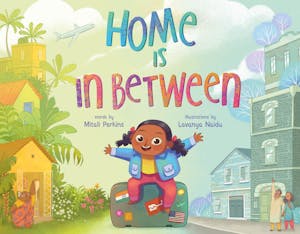
Asian Pacific American Lit: Home Is In Between


 Home Is In Between

Home Is in Between

A Review by Amanda Kendall

Bibliography:
Perkins, Mitali. 2021. Home is in Between. Ill. by Lavanya Naidu. New York: Farrar Straus Giroux. ISBN 0374303673
 
Plot Summary:
Shanti moves from the "warm monsoon rains" (Perkins 2021) of India to a "town with cold rain" (Perkins 2021) in the United States. Shanti finds her new apartment still feels like her old village but everything outside of that is very strange and new. As she starts school, makes friends, and learns the town she finds herself going back and forth. At home she learns to Kathak with her Ma and learns Bangla letters with Baba. Out of the house she goes to ballet and laughs at Hollywood movies with her friends. Her parents hold tight to the village and her friends show her the town. Pretty soon, Shanti is exhausted from bouncing back and forth between to cultures and needs to rest. She wakes up ready to embrace her bi-cultural life find her home is right there in the in between.

Critical Analysis:
Perkins and Naidu have created a beautifully authentic celebration of growing up as a first generation immigrant in the United States. Perkins skillfully contrasts Shanti's two worlds on every double page spread. From watching Bollywood films with her family to laughing at Hollywood movies with her friends and learning to dance Kathak with her Ma to visiting a ballet class with Tonya, Shanti is constantly immersed in both worlds everyday. Each double page spread shows Shanti experiencing similar things but in different ways. For example, Baba teaches Shanti Bangla letters one one page and then Shanti reads The Little Engine that Could to Baba in English on the page that follows. The structure of the text along with the repetition of the lines "back and forth she ran....again and again. In between" (Perkins 2021) emphasize how Shanti switches from one culture to another as she grows up in both at the same time and how exhausting this back and forth can be. Shanti is finally able to find peace when she realizes that she is from the in between or "the space between cultures" - equally part of both.

Naidu's illustrations are vibrant and almost cartoon like in design. She fully captures the two cultures that make up Shanti's life from the very beginning. The village on the first page is lush and filled with green foliage, while the illustration of the town that follows is rainy and grey. The vibrancy of the village not only captures the authentic foliage and landscape of India but mirrors Shant's feelings toward the two places. The town is initially shown as rainy and grey, unwelcoming, and difficult to understand, but as Shanti finds her place in her new life the town warms up to become as vibrant as her home in the village. In the end, both places are filled with life and color and prove to be an important part of Shanti's identity.
 
Naidu's skillfully uses facial expressions throughout the book to capture character emotions and expand on the text. For example, when Ma and Shanti are in the restaurant, you see Shanti looking around the corner curiously while Ma looks troubled reading the menu.  A few pages later, Ma is checking out at the store while other customers are seen scowling and checking their watch. Shanti is scowling right back. In these little moments a picture is worth a thousand words, capturing Shanti's joy, pain, bewilderment, exhaustion and everything in between. Illustrations range from full page spreads to square box vignettes that showcase Shanti's experiences in both worlds, often with Shanti walking back and forth between the pages. Each illustration is carefully laid out to emphasize the back and forth of Shanti's life as she code switches between her two worlds. 
 
Cultural markers fill the text and illustration on every page. The characters are authentically represented in skin tone, dress, and hairstyle. Stereotypes are avoided entirely, with characters that are proudly showing off their culture on each page. Perkins includes many cultural references including luchi, a Bengali puffed deep fried bread and frequent mentions of Bangla, the Bengali language. Shanti watches Bollyhood films, celebrates Holi, and plays the harmonium. The entire book from cover to cover is a celebration of the combining of American and Indian culture within Shanti. In the author's note, Perkins explains her own experiences growing up as a first generation immigrant and her desire to understand "American manners, slant, trends and rituals - the "code" at school" while also "trying to stay fluent in traditional Benglai culture and language - the "code" of home" (Perkins 2021). She goes on to explain how this code switching has become her greatest superpower and offers hope to those immigrants in similar situations. The book wraps up with a helpful glossary of terms and a pronunciation guide for readers. 
 
With detailed expressive pictures and thoughtfully written text, Home is In Between shows readers the beauty and power of being a first generation immigrant, proof that one can have their American identify while holding on to their cultural identity in the perfectly balanced in between.


Review Excerpts & Awards: 
 
BOOKLIST (June 1, 2021) "Reflecting the experiences of Perkins and many other immigrant children, this heartfelt picture book records the push/pull of remembering the old ways while learning the new ones. Lively and specific in its references, the writing sets up cultural dichotomies that work particularly well in expressive, richly colored artwork by Naidu, an Indian animator and illustrator. By shining a light on one girl’s story, this vibrant picture book illuminates the experience of many immigrant children"
 
PUBLISHER'S WEEKLY (January 4, 2021) "Animation-style characters by Naidu (Susie Will Not Speak) reflect emotion clearly, while straightforward writing by Perkins (Between Us and Abuela) shows how Shanti learns to appreciate aspects of her new life while keeping people and elements from her old one close to her heart.

 Curricular Connections:

  • Shanti learns many new things throughout the book. Have students learn something new. From learning a new recipe to learning a new trick on the bike encourage students to try something new to broaden their experiences.
  • Shanti's identity continues to grow and change throughout the book. Have students make an identity web about themselves.

Sunday, November 14, 2021

Asian Pacific American Lit: Grandfather's Journey

 Grandfather's Journey

Grandfather's Journey: Say, Allen: 8601423420011: Amazon.com: Books

A Review by Amanda Kendall

Bibliography:
Say, Allen. 1993. Grandfather's Journey. Boston: Houghton Mifflin Company. ISBN 0544050509
 
Plot Summary:
When Allen Say's grandfather was a young man he left Japan and went to explore the world. He traveled by boat, train, riverboat, and foot. He saw the oceans, fields, mountains, and rivers, but his favorite place was California. Say's grandfather settled in California, returning to Japan to marry and then choosing to raise his family in San Fransisco. When his daughter was a young woman, he returned to Japan with his family and found solace in his old friends and childhood mountains and rivers. Eventually, the grandfather's daughter got married and Allen was born. Allen grew up spending time with his grandfather and hearing stories of his travels. Although Grandfather never returned to California, Allen did and found a lasting connection with his grandfather: the feeling of home in both countries.

Critical Analysis:
Allen Say's delightful tribute to his grandfather celebrates his life and his experiences as an American immigrant. The text is is beautifully crafted, yet clear and concise. Each page has a sentence or two that pauses at the important life milestones of his grandfather. Broad transitions are used to show the passage of time. For example, Say writes "After a time, he returned to his village in Japan to marry his childhood sweetheart. Then he brought his bridge back to his new country" (1996).  There is no way to measure the amount of time Say's grandfather remained in any one place, but rather that he was there and then he moved on. Delicately balanced to include the moments in life, the beauty of the world traveled, and the reflection of the life's journey, the text thoughtfully walks the reader through Grandfather's life.
 
Say's gorgeous illustrations are powerful and calming. Each illustration is outlined with a black border framing the illustration in simple elegance. The soft color palette, curved shapes, and inclusion of landscape images create gentle images throughout the book.  Many of the illustrations are portraits that frame Say's grandfather and family in a moment in time much like a photograph. The people are posed exactly as they would have been in a photograph from that era. One of the most impressive aspects of the illustrations is the accuracy and historical context of each one. For example, in the illustration of Say's mother as a young girl she is seen with a blonde hair, blue eyed doll, showing her access to American cultural toys rather than a doll that represented her cultural heritage or family. This subtle inclusion of the baby doll is an excellent example of how Say includes some of the realities of being a Japanese American. 
 
Cultural markers are beautifully woven into the illustrations and simple elegance of the story.  The characters presented are authentic in appearance, dress, and cultural representation. The first page introduces Say's grandfather in traditional Japanese attire, and then shows his change to European clothes for the journey to America. The first time in European clothes, he is pictured in a too large coat and awkwardly holding his hat, showing how he is uncomfortable in this change but bravely taking it on. In the pages that follow, the clothes are a better fit illustrating how Say's grandfather has found his place in America. We see similar cultural markers with clothing throughout the book. Say's mother is shown as a young woman in both an American style dress and hat when arriving in Japan and then in a Japanese kimono for her wedding. By showing characters in both styles of clothing, the reader understands how they are a part of each culture.

Themes of immigration, family, and nature are strong throughout the memoir. Say's grandfather is drawn to the beauty of the world and he is continually amazed by the splendor of the mountains and oceans. Whether in Japan or California, his appreciation and love of nature is apparent. Family is another strong theme throughout the story. Many of Say's grandfather's decisions in life were made with family in mind. He returns to Japan to marry is childhood sweetheart. He moves to a larger city in Japan to accommodate his San Fransisco born daughter. Family is a guiding force for his life decisions. Not only is Say sharing his grandfather's immigration story, but also his own. Mirroring his grandfather's love of adventure, Say immigrates to the United States and finds a home in California while keeping his ties to his home in Japan. Here, Say captures the immigrants experience of being a part of two different worlds and finding they are both a strong part of their identity saying, "The funny thing is, the moment I am in one country, I am homesick for the other" (Say 1996).


Review Excerpts & Awards:   
 
PUBLISHER'S WEEKLY (August 16, 1993) "Say transcends the achievements of his Tree of Cranes and A River Dream with this breathtaking picture book, at once a very personal tribute to his grandfather and a distillation of universally shared emotions. Elegantly honed text accompanies large, formally composed paintings to convey Say's family history; the sepia tones and delicately faded colors of the art suggest a much-cherished and carefully preserved family album."
 
SCHOOL LIBRARY JOURNAL (September 1993) "A personal history of three generations of the author's family that points out the emotions that are common to the immigrant experience. Splendid, photoreal watercolors have the look of formal family portraits or candid snapshots, all set against idyllic landscapes in Japan and in the U.S."
  •  Caldecott Medal, 1994

 Curricular Connections:

  • Say shares a story from his family's history. Invite students to interview an older relative about their childhood and/or younger years. Encourage students to learn more about their family history.
  • Birds are an important symbol used throughout the book. Say's grandfather keeps warblers and silver eyes when living in Japan and other various songbirds while living in America. Conduct some research about birds local to the area in which you live. What types of songbirds live in your area?

Monday, November 1, 2021

Native American Lit: Crossing Bok Chitto


 Crossing Bok Chitto:

A Choctaw Tale of Friendship & Freedom

A Review by Amanda Kendall
 Crossing Bok Chitto: A Choctaw Tale of Friendship & Freedom: Tingle, Tim,  Bridges, Jeanne Rorex: 9781933693200: Amazon.com: Books
Bibliography:
Tingle, Tim. 2006. Crossing Bok Chitto: A Choctaw tale of friendship & freedom. Ill. by Jeanne Rorex Bridges. El Paso, Texas: Cinco Puntos Press. ISBN 0938317776
 
Plot Summary:
In the early nineteenth century, there was a river in Mississippi called Bok Chitto. The river separated the Choctaw Nation and American plantation owners and the enslaved people who lived there. The river acted as a border if an enslaved person made it across the river, they were considered free. 
 
Martha Tom, a young Choctaw girl, was sent by her mother to find blackberries. When she couldn't find any on the Choctaw's side of the river, she crossed. On the other side she found both blackberries and dozens of enslaved people attending the forbidden slave church. She was quickly discovered and escorted home by a young enslaved boy, Little Mo. Although they were from different sides of the river, the two became fast friends. When Little Mo's mother is sold from the plantation, he suggests to his family that they cross Bok Chitto to get to freedom. Desperate to save his family, Little Mo goes to Martha Tom for help. Martha organizes all the women in the village bring a candle to the river while dressed in white. Looking like angles, the Choctaw women distract the guards and bring Little Mo and his family safely across the river to freedom.
 
Critical Analysis:
 As a member of the Choctaw Nation, Tingle tells the story of Crossing Bok Chitto with honesty and authenticity. In his author's note he states that, "We Choctaw live by our stories" (Tingle 2006). This natural ability to tell a good story comes across on each page. There is a casual note to the narration that adds to the storytelling experience and makes the story accessible and engaging for all ages. 
  
Tingle's story is captivating from the beginning, explaining the significance of a single river and the power of crossing it. As the story unfolds, each character shows both fear and courage as they trust each other with their lives. The friendship developed between Little Mo and Martha Tom develops naturally, clearly showing respect for the other's culture. Tingle shows this mutual appreciation through the story. First when Little Mo visits the Choctaw side of the river and hears old men chanting. He says "it touched him deeply." And when Martha Tom starts attending church every Sunday to listen to the preacher and sing songs.
 
Bridges's illustrations aptly pair with the storytelling style of the text. The illustrations capture the  sweet yet somber mood of the story with muted colors and blurry backgrounds. Skin tones, clothing, and hairstyle and structure all reflect cultural and historical authenticity. In the image of Martha Tom and Little Mo crossing the hidden rocks in the river, the reader is drawn to the authentic Choctaw shoes while Little Mo is seen barefoot and in torn pants. The entirety of the story takes places outside and Bridges's illustrations are a beautiful blend of natural colors and hues. Finally, Bridges's captures the emotions of the characters fully with her expressive faces throughout the story. Many pages feature large full front portraits of characters, highlighting their emotions throughout the story. She elegantly captures the pain and sorrow of Little Mo and his family, as well as the determination and strength of the Choctaw women who come to the family's aid. 

Themes of family, empathy, friendship, and bravery ring true throughout the book. Tingle and Bridges have collaborated to create a tale that honors and celebrates the many different Native Nations that helped enslaved people find freedom (Tingle 2006). Cultural markers are embedded throughout the story and naturally incorporated into the illustrations. Tingle includes lyrics to Choctaw songs as they are still sung today, "Way, hey ya hey ya" (Tingle 2006) and includes a song from the forbidden slave church translated into Choctaw. All of these elements, plus the after notes at the end of the book provide the reader with the most authentic experience learning about the Choctaw in the past and today. Tingle's note links the past with the present, as the Choctaw Nation remains large, prosperous, and strong with a natural inclination to tell a good story (Tingle 2006).

Review Excerpts & Awards: 

BOOKLIST (April 15, 2006) "In a picture book that highlights rarely discussed intersections between Native Americans in the South and African Americans in bondage, a noted Choctaw storyteller and Cherokee artist join forces with stirring results...In her first paintings for a picture book, Bridges conveys the humanity and resilience of both peoples in forceful acrylics, frequently centering on dignified figures standing erect before moody landscapes."
 
SCHOOL LIBRARY JOURNAL (July 1, 2006) "Tingle is a performing storyteller, and his text has the rhythm and grace of that oral tradition. It will be easily and effectively read aloud. The paintings are dark and solemn, and the artist has done a wonderful job of depicting all of the characters as individuals, with many of them looking out of the page right at readers. The layout is well designed for groups as the images are large and easily seen from a distance. There is a note on modern Choctaw culture, and one on the development of this particular work. This is a lovely story, beautifully illustrated, though the ending requires a somewhat large leap of the imagination."
  • American Indian Youth Literature Award, 2008
  • ALA Notable Children's Books, 2007
  • Bluebonnet Award Nominee, 2008-2009

 Curricular Connections:

  • Tim Tingle writes "modern business and traditional culture live comfortably side-by-side" when describing the life of the Mississippi Choctaw today. Research more on the Choctaw tribe to learn what traditions endure today.

Saturday, October 30, 2021

Native American Lit: Birdsong

Birdsong

A Review by Amanda Kendall
Birdsong (picture book) - Wikipedia

Bibliography:
Flett, Julie. 2019. Birdsong. Vancouver: Greystone Books. ISBN 1771644737
 
Plot Summary:
In the span of a year, Katherena's life changes dramatically. In the spring, she moves with her mother from a house by the sea to a new home in the country. In the summer, her mother encourages her to go visit their older neighbor, Agnes whom Katherena instantly bonds with over a love of art and creating. In the fall, Katherena visits Agnes again and again, each visit bringing the two friends closer. In winter, Agnes gets sick and Katherena brings her salmon soup. When spring rolls around again, Katharena visits her friend to bring the beauty of nature to Agnes's bedroom.The two talk about art and enjoy the silence of each other's company. When Katherena leaves she reflects on how privileged she is to have Agnes as a friend.

Critical Analysis:
Julie Flett's talent for storytelling and creating are exquisitely showcased in Birdsong. A Cree-Metis author and illustrator, Flett shares her cultural background throughout the picture book. The thoughtful text sets a slower pace for this read and creates a reflective mood throughout the story. Simple sentences are expertly crafted to paint images in the readers mind and evoke emotion. For example in the line "It's a murky spring morning as we pack up the last of our belongings and leave our little home in the city by the sea" (Flett 2019) the words are simple enough, but the imagery is strong and the sadness of the character palatable. Strong descriptive words and meaningful dialogue move the story along at just the right pace showing the passing of time in both the everyday and the friendships developed over time.
 
Flett's pastel and pencil illustrations are soft and emotional. The natural colors and textures compliment the mood of the text. The earthy tones match the story's seasonal structure and bring a sense of calm and order to the story. In addition to the use of natural tones, Flett includes other authentic cultural markers throughout the text. Her characters are authentically represented in skin tone and show the everyday life of someone sharing her culture. The illustrations have a strong focus on nature and the natural order that nature brings to the world. The color tones, textures, and soft sometimes blurry lines, create soothing images. Flett focuses on birds throughout the illustrations, including a different species on almost every page. At times, the birds are the focus of the illustration as when the geese fly south for winter and other times they are subtly included sitting in a tree outside a window. The story and birds come full circle in the end when Katherena's drawings of each bird are put up around Agnes's room. Beautifully crafted, each illustration enhances the story and impresses the importance of connection to nature and creativity.
 
Cultural markers of the Cree-Metis people can be found flawlessly woven into the text. Authentic names are used for characters like Katharena and her dog, Ôhô which means owl in Cree. Katharena also tells Agnes about the Cree seasons, explaining that the current month "is called pimihâwîpisim - the migrating moon" (Flett, 2019). Katharena sleds on a toboggan and makes salmon soup to take to her friend. These small details help paint a beautiful authentic picture of a young Cree girl who has found a true friend in her neighbor.
 
Ultimately, Birdsong is a celebration of friendship. The friendship that develops between Katharena and Agnes shows how friendships can develop through shared interests regardless of age. It is the art and act of creating things that brings them together. Strong themes of nature, friendship, the passage of time, and finding beauty in the small moments all make this book a charming book about life.

Review Excerpts & Awards: 

PUBLISHER'S WEEKLY (September 30, 2019) "Cycling from spring to spring, Flett's subtle, sensitive story delicately traces filaments of growth and loss through intergenerational friendship, art making, and changing moons and seasons. Cree-Métis words (defined in a small glossary) add an intimate layer of identity to the child’s lustrous narration, which shines against the spare beauty of rich illustrations by Flett (who is Cree-Métis)"
 
KIRKUS REVIEWS (July 1, 2019) "Flett’s simple story explores the difficulties of moving but also shows young readers how new friends can sometimes ease them; that this friendship is an intergenerational one between fellow artists is an especially sweet touch. Flett (Cree/Métis) employs her characteristically minimalist style, placing Katherena against flat expanses of greensward that changes with the seasons, birds wheeling above in silhouette. Katherena and her mom both have brown skin and straight, black hair; Agnes has brown skin as well, but she does not speak Cree. Emotionally stunning.
  • Winner of the TD Canadian Children's Literature Award, 2020
  • American Indian Youth Literature Honor Title, 2020
  • A Boston Globe - Horn Book Honor Book
  • Best Book of the Year: Publisher's Weekly, School Library Journal, Kirkus, Horn Book, Quill & Quire, Globe and Mail

 Curricular Connections:

  • Seasons are an important element of the book. Have students create a collage of their favorite season using a variety of materials and textures.
  • Friendship is an important theme in Birdsong. Discuss what makes a good friend using examples from the book and create an anchor chart for reference.
  • Moving to a new place is difficult. Pair this text with Evelyn Del Rey is Moving Away by Meg Medina to explore how friendships may change and develop during this transitional time. 
  • Create a character change visual using a circle divided into 4 equal parts to show how Katherena changes throughout the year, season by season.

Monday, October 11, 2021

Latinx Lit: Carmela Full of Wishes

  Carmela Full of Wishes

A Review by Amanda Kendall
Carmela Full of Wishes by Matt de la Peña, Christian Robinson, Hardcover |  Barnes & Noble®
 
Bibliography:
de la Peña, Matt. 2018. Carmela Full of Wishes. Ill. by Christian Robinson. New York: G.P. Putnan's Sons. 9780399549045
 
Plot Summary:
Carmela starts her birthday with candles on her pancakes and the knowledge that she is finally old enough to go with her big brother. The two walk through their thriving community together until they arrive at the local laundromat. There, Carmela finds a lone dandelion puff on the sidewalk. She picks the dandelion and carries it through her community.  From a vending machine that has anything you could desire to a fancy bed for her mother and proper paperwork for her father, Carmela imagines all the wishes she would like to make but is unable to decide how to best use her one dandelion. When Carmela crashes on her scooter, drops the dandelion, and loses her wish that her brother comes to her rescue. He takes her to the beach with a field of dandelion puffs, helping her hold on to hope, and see "the sky is full of wishes" (de la Peña 2018).

Critical Analysis:
Matt de la Peña and Christian Robinson prove to be master storytellers with each collaboration. Carmela Full of Wishes is no exception. Peña's text is elegant and precise. His word choice turns each page into a celebration for the senses. His words trigger the sights, sounds, and smells of Carmela's neighborhood for the reader. Her bracelets are "jingling and jangling" (de la Peña 2018), the air smells of "marigolds and overturned earth and fresh manure" (de la Peña 2018), carts are rattling, and brothers are giving annoyed looks. All of these realistic details are woven into the story repetitiously, creating a beautiful narrative that connects each page to the last. As Carmela and her brother journey through town, Peña repeats the sounds of Carmela's bracelets jingling and the word imagining as she thinks of all her wishing possibilities.  Peña also uses repetition throughout the text to create continuity within the story. His dialogue follows this recipe for success and captures a true sibling relationship of both annoyance and support from beginning to end. All in all, Peña's creative choices make Carmela Full of Wishes a joy to read aloud. 
 
Robinson's illustrations compliment and enhance the text every step of the way. His signature collage and paint illustrations are filled with vibrant colors and well used white space. Some pages exude happiness with bold, bright backgrounds while other pages are left more sparse allowing the illustrations to match the feelings of Carmela throughout the story. The characters authentically represent the Hispanic community in the story and include people of all ages and even an expectant mother. They reflect real life and a real community. Cultural markers of the Latin community can be found in many of the backgrounds of the illustrations. For example a flower sign reads "Rosas Flores" and the corn food cart is located right outside the panadería. One of the most eye catching cultural markers is the illustrations of Carmela's wishes. Each wish is showcased in the style of a papel picado, a traditional style of Mexican folk art that involves cutting paper to create intricate designs. Robinson expertly illustrates Carmela's wish coming true within the paper flags design filling the page with unmistakable and well designed cultural reference. 
 
Peña and Robinson's collaboration shows an authentic experience in the Latinx community. Skillfully executed, the picture book has many layers to be explored and understood.  Subtly including themes of labor and immigration, some readers may miss these cultural markers while others may feel seen for the first time, a powerful mirror for these children. For others, it opens a window to the authentic experiences of many and provides an opportunity for important conversations. The book opens with Carmela scooting past the workers in field and the green houses. She mentions walking past the home improvement store where her dad used to wait for work. Her wish for her mother is to sleep in one of "fancy hotel beds" she made. Each one of these examples is Peña's quite way of showcasing the many labor experiences of his community. The theme of immigration is gently touched upon when Carmela imagines her dad "getting his papers fixed so he could finally he home" (de la Peña 2018). The final scene at the beach with the sky filled with dandelion seeds ends the story on a positive and hopeful note. There are always more wishes. There is a "sky full of wishes" (de la Peña 2018). You don't have to pick just one.

Review Excerpts & Awards: 

PUBLISHER'S WEEKLY (July 30, 2018) "The award-winning team behind Last Stop on Market Street portrays Carmela's Spanish-speaking community as a vibrant place of possibility, and Robinson's acrylic-and-cutout spreads introduce readers to street vendors, workers in the fields, and sweeping views of the sea. Sensitively conceived and exuberantly executed, Carmela's story shines."
 
KIRKUS REVIEWS (September 1, 2018) "This second de la Peña–Robinson collaboration after Last Stop on Market Street is no less powerful and beautiful. It touches on immigration, class, and loss without belaboring each. And it’s full of rich details, sharp and restrained writing, and acrylic paintings that look textured enough to rise off the page. In one brilliant sequence, Mexican papel picado depicts what Carmela imagines, ending with “her dad getting his papers fixed so he could finally be home” and a cutout of a kneeling father embracing his daughter. It’s a bracing page, the best in the book, and just as sublime as the text. It’s another near-perfect slice of life from a duo that has found a way to spotlight underrepresented children without forgetting that they are children first."
  • Publishers Weekly Most Anticipated Children’s Book – Fall 2018
  • Publishers Weekly Best Book of 2018
  • Kirkus Reviews Best Picture Book of 2018
  • Boston Globe Best Children’s Book of 2018

 Curricular Connections:

  • Carmela thinks hard about her wish. She imagines things like a vending machine that has whatever she wants but also imagines wishes that would improve the lives of the people around her. Like Carmela, have students hold on to hope and make a list of wishes they would like to see come true. 
  • Create a dandelion puff painting using white tempra paint and empty toilet paper rolls. Click here for step by step directions on using toilet paper rolls to create the dandelions.
  • Carmela's birthday is special because of the experience she shares with her brother. Use Carmela Full of Wishes as a mentor text to spark ideas in writing. Have students write about a special memory with a loved one.
  • Create your own papel picado project. Step by step directions can be found here.

Thursday, October 7, 2021

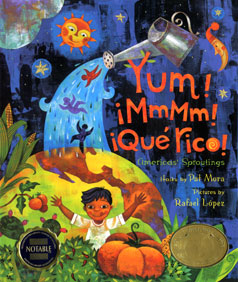
Latinx Lit: Yum! ¡MmMm! ¡Qué Rico!: Americas' Sproutings

 Yum! ¡MmMm! ¡Qué Rico!: 

Americas' Sproutings

A Review by Amanda Kendall
 Yum! ¡Mmm! ¡Qué Rico! America's Sproutings

Bibliography:
Mora, Pat. 2007. Yum! ¡MmMm! ¡Qué Rico!: Americas' Sprouting. Ill. by Rafael López. Orlando: Voyager Books. 0152000769
 
Plot Summary:
In this collection of haiku poems, Mora takes the reader on a tasty journey of native foods from the Americas. Each food is celebrated in a beautiful double page spread that includes a haiku, an informational paragraph of the history of the food, and vibrant illustrations. From blueberries from Maine to tomatoes from Peru, the chosen foods represent the wide variety of delicacies found on the two American continents. All 14 delicious poems capture the unique qualities of the food and honor the impact each one has had on the diverse cultures of the Americas.

Critical Analysis:
Yum! ¡MmMm! ¡Qué Rico! is a celebration of food, culture, and poetry! Mora's words masterfully use the five, seven, five rules of haiku to capture the essence of each food. Filled with powerful imagery that excites all the senses, readers find themselves immersed in the food in only a few lines. Cranberries are described as "Marsh-floating hard bead/ simmers then POPS! in hot pot/ Scarlet fireworks" (Mora 2007). Each food seems to come alive in those seventeen syllables. Mora also captures the experiences of eating the foods. In the poem "Chile" she writes, "Dad bites green mouth-fire/ laughs when tears fill his eyes, sighs/ ¡Mmmm! This heat tastes good" (Mora 2007). Mora's words paint a picture of both the food and the experience with humor and creativity. The addition of informational paragraphs on each page add to the overall appeal of the text.  Each brief history includes the believed origins of the food, the first uses of the food, and other unique fun facts about each. For example, a papaya can weigh as much as twenty pounds (Mora 2007).
 
The text is made even more engaging through López's joyful and vibrant illustrations. Each page is work of art. López layers colors and varies hues to create beautiful details on each page while using brightly colored textured backgrounds to give each illustration depth and complexity. The people and cultures are authentically and skillfully represented with many images paying homage to the artistic style of Diego Rivera. Filled with humor and joy, these lively illustrations match perfectly with Mora's poems.
 
Cultural markers for this text are woven into the poetry and illustrations. When describing the prickly pear, Mora writes, "Cactus fruit becomes syrup/ and dulces. Surprise!" (Mora 2007). Mora uses both Spanish and English words in her poetry, blending the two languages seamlessly in several poems. López's illustrations authentically represent the many different Latin cultures found within the book. He has authentically represented the people of the Americas with a variety of skin tones, hair styles, and dress. A man from Mexico is depicted wearing a Mexican palm cowboy hat with a modern brim showing that López's illustrations avoid stereotyped or outdated clothing choices. Animals, plants, and instruments like maracas and the timba are also carefully chosen to represent the cultures of a food's origin. Details in each page were carefully chose to authentically reflect the culture behind the food. López even includes traditional housing of the Pueblo in the background of the corn haiku. López has accurately, respectfully, and fully represented the Americas within these pages.
 
Because this is a celebration of foods originating in the Americas, the poems include foods from North, Central, and South America. The political borders have been erased and foods native to the people and cultures of the lands emerge. In the author's note, Mora explains her appreciation of variety in foods, language, people, and poetry (Mora 2007). This celebration of diversity in the native foods of Americas and the cultures that sprouted from these foods is a wonderful way to celebrate the Latinx experience.


Review Excerpts & Awards: 

BOOKLIST (December 1, 2007) "This inventive stew of food haiku celebrates the indigenous foods of the Americas. Each of the 13 poems appears on a gloriously colorful double-page spread, accompanied by a sidebar that presents information about the origin of the food. From blueberries to prickly pears to corn, the acrylic-on-wood-panel illustrations burst with vivid colors and stylized Mexican flair"
 
SCHOOL LIBRARY JOURNAL (September 1, 2007) "This concept book serves as a delicious introduction to 14 types of food, all of which have their origins in the Americas. Snippets of information and a haiku poem accompany each one, ranging from blueberry and chili pepper through papaya, prickly pear, and vanilla. Using English and a smattering of Spanish words, Mora crafts a playful introduction to each one, as in "Pumpkin": "Under round luna,/scattered tumblings down the rows,/autumn's orange face." The sense of whimsy is further underscored in L-pez's colorful acrylic on wood-panel illustrations. Artful compositions and brilliant complementary colors bear out the book's multicultural themes."
  • Amérias Award for Children’s and Young Adult Literature Commended Title , 2008
  • Texas Bluebonnet Award (TBA) Master List, 2008-2009
  • ALA Notable Children's Books, 2008
  • Chicago Public Library's Best of the Best Books, 2008
  • Bank Street Best Children's Books of the Year, 2008
  • Lasting Connections, Book Links, 2007
  • Great Lakes Great Books Award Master List, 2008-2009

 Curricular Connections:

  • Have students write their own favorite food haiku. Display with pictures of the foods drawn by students.
  • Pair with a social studies lesson on the Colombian Exchange. Learn about old world and new world foods. 
  • Conduct a mini-research project on a favorite food. Where did it originate? What's the history of that food or recipe? Students can share the background of their favorite foods with the class through an online platform like SeeSaw or FlipGrid. 
  • Watch a video of Pat Mora talking about her writing in general and specifically about this book.

Saturday, September 11, 2021

International Literature: Cannonball

Cannonball

A Review by Amanda Kendall


Bibliography:
Cotter, Sacsha. 2020. CANNONBALL. Illustrated by Josh Morgan. Naperville, Illinois: Sourcebooks Jabberwocky. ISBN 978-1728217567
 
Plot Summary:
In New Zealand, nothing brings kids greater joy than doing the perfect cannonball in the summer. But perfection is not easily achieved. In CANNONBALL, one young boy seeks out the advice of people around town to elevate his cannonball to legendary status. He attempts to incorporate everyone's well meaning advice from bigger shorts to more height, but he just can't seem to get it right. After a defeating cannonball turned belly-flop, he goes to his Nan who advises him to listen to his heart and find a way to do it his own way. Finding his voice gives him the courage to make the perfect splash!

Critical Analysis:
In an explosion of summer, Cannonball's lively illustrations, rhythmic text, and celebration of individuality make this book an overall crowd-pleaser. Cotter's text is highly interactive. The first person point of view invites the reader to experience the story right along with the protagonist. Pages alternate between those that follow a distinct rhythm and rhyming pattern and others that don't. Awkward at first, this irregularity is critical to the flow of the text and highlights the emotions the characters experiences throughout the story. After every disappointment, the text swings back to a happy,cheerful rhyme encouraging both the boy and the reader not to give up. Cotter's repetitive use of the boy's chant before jumping in the water shows his evolution as a character. While the words remain the same, the voice that he uses to express those words builds along with his confidence. Paired beautifully with the pictures, the final chant begs to be screamed as the boy leaps into the water doing a perfect cannonball his own way!

Morgan's illustrations capture of the joy of summer. His choice of vivid colors and unique texture backgrounds make each page a visual delight. The inclusion of math symbols, tools, numbers, and grid paper background on the first few pages cleverly conveys the complexity of the perfect cannonball and the boy's dedication as he thinks about it from every angle. This attention to detail continues through the variety of illustrations in the book. Some are full page color. Some are a collection of smaller images mashed together. Many pages have a simple white background, focusing the reader's attention on the characters while other full page spreads capture the beauty and vibrancy of New Zealand. The boy's final fabulous cannonball is brilliantly broken into a four panel spread. Following this slow motion cannonball is a magnificent double page SPLASH that requires the reader to turn the book vertically to see it.

Cannonball is a celebration of New Zealand and the Maori people, the indigenous Polynesian people of the New Zealand mainland. The characters are authentic and true. The boy's hair is pulled back in a traditional Maori bun and the necklace he wears is a traditional jade Maori necklace. The design is a manaia or spirit creature which symbolizes a spiritual guardian. Maori words are used throughout the story including a postcard that reads "Nga Mihi" which means greetings for the new year. Manu (meaning bird) and puku (meaning stomach) are both used within the text as well. Cotter even provides a glossary of Moari words and types of dives in the back of the book for the reader. The unique setting of New Zealand is captured in the illustrations in big and small ways. Morgan's illustrations include a wide array of plants and animals found only in New Zealand. The New Zealand Kingfisher bird makes multiple appearances throughout the story with its highly recognizable coloring and markings. The boy is seen sitting in a New Zealand Christmas Tree and red flowers from the Pohutukawa tree along with the yellow kowhai flowers are both a part of the boy's final cannonball ensemble. Lastly tauparapara or chants are used by the Maori people to pass on knowledge. The boy's cannnonball chant is another example of the Maori tradition embedded in the story.
 
Cannonball wins over the reader a little more with each subsequent read. The ideas of being yourself and finding your voice are strong themes and well executed, but it is the vivacious illustrations and sometimes silly but fun text that make this book pure joy to read aloud!

Review Excerpts & Awards:
 
SCHOOL LIBRARY JOURNAL (June 1, 2020) "Along with the expressive images, the story will resonate with those learning how to navigate the emotional minefield of turning a failure into a success."

KIRKUS REVIEWS (May 1, 2020) "This distinctive story of summer fun and growth, set within a culture underrepresented on North American shelves, carries a universal message of listening to one’s own heart and being oneself when the world tries to tell you how and who to be."
  • USBBY Selection, 2021

Curricular Connections: 

  • In CANNONBALL, the boy has a chant he says before each cannonball attempt. Have students write a new chant that inspires them to listen to their voice and gives them the courage to try something new.
  • Have students think about the advice they have been given in the past. Who gave good advice? Who gave poor advice? Discuss how you know if it is good or bad advice? How do you know whose advice to follow?
  • Share the glossary at the back of the book that includes Maori words. Have students research more about New Zealand and the Maori people using online resources.

Friday, September 10, 2021

International Literature: Koala Lou

Koala Lou

A Review by Amanda Kendall


Bibliography:
Fox, Mem. 1989. Koala Lou. Illustrated by Pamela Lofts. Orlando: Voyager Books. ‎ ISBN 978-0440846512

Plot Summary:
Koala Lou is loved and adored by everyone in her world, especially her mother who takes every opportunity to tell her "Koala Lou, I DO love you" (Fox 1989). But as the years go by, Koala Lou's family continues to grow until her mother no longer has the time to tell her how much she loves her. Devastated and hurt that she has lost her mother's love, Koala Lou sets off to win it back. She trains for the gum tree climbing event in the upcoming Bush Olympics. On the day of the big event, Koala Lou gives a very impressive performance but still comes in second place. She runs off to hide and cry. She returns home to find her mother waiting to embrace her in a giant hug and the comforting words she longed to hear, "Koala Lou, I DO love you" (Fox 1989).

Critical Analysis:
Koala Lou is filled with universal truths that will resonate with readers young and old. It captures common feelings of older siblings: feelings of losing the affection of someone you love; feelings of being replaced or pushed aside; feelings of working hard and still falling short and; feelings of coming home to find comfort. It is more than a simple story about a koala.
 
Fox's lyrical text is expertly paced. Each page has a small to moderate amount of text with just the right dose of repetition to keep even the youngest readers engaged. Fox effortlessly weaves simple sentences with complex to create an accessible story for her young readers. The repeated use of the line, "Koala Lou, I DO love you" brings continuity throughout the story and clearly conveys the power of a mother's unconditional love. Mem Fox honors the big feelings of her young readers through Koala Lou's thoughts, actions, and lessons learned along the way.

Lofts' detailed illustrations are both vibrant and soft at the same time. The blends of colors and texture soften the images to match the sweetness of the text, yet the occasional use of bright pink, orange, and purple make the images pop off the page.  The white background strategically focuses the reader's attention on the character's facial expressions and emotions throughout the story to make Koala Lou even more relatable to her readers. Splashes of bright color are added into trees, flowers, and the animal's accessories (specifically hats) capturing the magic and celebration of the Australian outback. 

Cultural markers for this text are beautifully woven into the rich story through the illustrations. Set in the Australian outback the illustrations include a wide variety of fauna native only to Australia including the koala, kookaburra, Tasmanian devil, platypus, echidna, emu, and more. Lofts took great care to capture the flora of Australia as well including the very recognizable red flowering gum tree, kangaroo paw, and old man banksia. With the exception of the colorful hats worn by the animals, every image reflects the unique Australian landscape. Fox adds to the authenticity of the story by including  an Australian colloquialism, "How're ya goin'?" and using meters to measure the distance Koala Klaws and Koala Lou climb on the gum tree. Together, the illustrations and the text, prove to be a celebration of the Australian landscape and culture, while offering a story that resonates with readers across the globe.
 
Review Excerpts & Awards:
 
PUBLISHERS WEEKLY (August 11, 1989) "Koala Lou celebrates the eternal love of a mother for her child without the sentimentality of Robert Munsch's Love You Forever."

KIRKUS REVIEWS (1989) "This satisfying reworking of a familiar and ever-important theme is appealingly illustrated--bright colors, soft-edged sculptural forms, precise detail, dozens of expressive animals. Another winning import from one of Australia's favorite authors." 
 
  • KOALA Children's Choice Awards Shortlist, 1999 (10 years)

Curricular Connections: 

  • Pair with an informational text on koalas for some partner research or whole class learning. 
  • Conduct a koala directed drawing lesson encouraging students to use a variety of hues to color their koala like the illustrations from Pamela Lofts.
  • Research Australian flora and fauna to identify the animals and plants used in the illustrations.
  • Highlight the importance of sportsmanship and hard work while playing a variety of Minute to Win It games with a Bush Olympics theme.
  •  Share the background story of Koala Lou from Mem Fox's website and facilitate a discussion about how writers get ideas, develop their stories, and revise their work.

Saturday, March 24, 2018

Funny Bones

Funny Bones:
Posada and His Day of the Dead Calaveras
A Review by Amanda Kendall


Bibliography:
Tonatiuh, Duncan. 2015. Funny Bones: Posada and His Day of the Dead Calaveras. New York: Abrams Books for Young Readers. 1419716476

Plot Summary:
Skeletons and skulls have long been associated with El Dia de los Muertos, however these calaveras, as they are called, are the original creation of  Mexican artist Jose Guadalupe Posada. An artist from a young age, he learned the art of lithography, engraving, and etching. He worked at a print shop and used his artistic skills to make political cartoons and make people laugh. This was the beginning of his success and his printing career. He continued to illustrate many different cartoons and designs throughout his life, however his creations for El Dia de los Muertos were his most popular. He created beautiful images to accompany short rhyming poems for the day. People were both entertained and impressed with his talent and ability to say so much through his imagery. Although his art was enjoyed by many during his life, his work was not appreciated until long after his death. His work and details of his life continue to be discovered as people learn more about the incredible man behind the famous images.

Analysis:
Duncan Tonatiuh does a remarkable job of honoring the life and art of Jose Guadalupe Posada in Funny Bones.  He tells the story with direct specificity that allows the reader to easily follow along and enjoy. The inclusion of how to print using lithography, engraving, and etching adds to the reader's knowledge of art and design while supporting the understanding of Posada's process. Carefully planned and well executed, Tonatiuh's text provides an excellent overview of Posada's life, chronicles the development of the Calaveras images used in Mexican culture, and highlights the importance of his work today.

The illustrations play a vital role in the storytelling of this informational text. The illustrations are a mix of Tonatiuh's hand-drawn images and reprints of art by Jose Guadalupe Posada and Manuel Manilla.  Beautifully incorporated together, both styles of imagery complement the story of Posada's life.  At times the primary source material is mixed within Tonatiuh's art, while other times it is showcased on a page of its own.  Woven in perfect harmony with the text, the images convey the importance and political and social context of each piece of art throughout Posada's life. While Tonatiuh's artwork makes the book accessible for young readers, the inclusion of the original artwork makes the book look and feel even more authentic in a very unique way.

The book concludes with an incredibly informative author's note, a glossary of art and Spanish terms, and a bibliography and index.  These helpful tools allow the reader to continue their study of El Dia de los Muertos and Posada's art.  Well researched and beautifully presented, Tonatiuh shares the story of an artist whose legacy has altered the imagery of a timeless celebration in a fresh new way.

Awards & Reviews:
  • 2016 Sibert Award Winner
  • Pura Belpre (Illustrator) Honor Book
  • New York Times Best Illustrated Children's Books of 2015
  • International Latino Book Award Finalist
From Kirkus Reviews: "Tonatiuh further marks himself as a major nonfiction talent with this artistically beautiful and factually accessible offering that effectively blends artistic and political content for young readers."

From Booklist: "Playful but informative, this picture book offers a fascinating introduction to the artist and his work."

From School Library Journal: "A stunning work, with great possibilities for lesson plans or tie-ins with Day of the Dead."

Connections:
More Books by Duncan Tonatiuh:
  • Separate is Never Equal: Sylvia Mendez and Her Family's Fight for Desegregation. 1419710540
  • Dear Primo: A Letter to My Cousin. 0810938723
  • Diego Rivera: His World and Ours. 0810997312
  • Pancho Rrabbit and the Coyote: A Migrant's Tale. 1419705830
  • The Princess and the Warrior: A Tale of Two Volcanoes. 1419721305
More Books About El Dia de los Muertos:
  • Barner, Bob. The Day of the Day/ El Dia De Los Muertos. Translated by Teresa Mlawer. 0823423816
  • Bracegirdle, P.J. The Dead Family Diaz. 0147515580
  •  Keep, Richard. Clatter Bash! A Day of the Dead Celebration. 1561454613
  •  Thong, Roseanne G. Dia de los Muertos. Ill. Carles Ballesteros. 0807515663
  • Winter, Jeanette. Calavera Abecedario: A Day of the Dead Alphabet Book. 0152059067
Suggested Curricular Connections:
  • Host an El Dia de los Muertos celebration with pan de muerto, marigold flowers, sugar skulls, and paper cutouts. Build an ofrenda to honor people who have passed. 
  • Write about a loved one who has passed to remember and celebrate them.
  • Decorate a calaveras image with bright colors and marigolds to celebrate El Dia de los Muertos.
  • Recreated the lithography and etching processes using rubber stamps. 
  • Research and learn more about other Mexican artists.

Actual Size

Actual Size
A Review by Amanda Kendall


Bibliography:
Jenkins, Steve. 2004. Actual Size. Boston: Houghton Mifflin Company. 0547512910

Plot Summary:
From the two inch pygmy on the title page to the giant Gippland earthworm at the end, Actual Size features a variety of exceptionally large and unusually small creatures found all around the world. Highlighting specific features of larger critters and showcasing them to scale, the book captures the uniqueness and wonder of the animals it describes and ignites the curiosity of its reader with eye-popping illustrations and staggering statistics. This remarkable picture book concludes with a glossary of sorts, offering additional information on each animal and a matching illustration providing the reader with a clear visual of each creature.

Analysis:

Steve Jenkins has a exceptional knack for crafting informational books for young readers. His unique perspective gives readers an opportunity to see animals in exciting and unexpected ways. Actual Size is a brilliant example of how scope and perspective shapes a reader's understanding. The true to scale paper collage illustrations of a giant squid's eyeball and great white shark's teeth show the reader the immense size and magnitude of these animals. Whereas the pygmy mouse lemur's size is more fully understood when placed next to a full-scale image of a gorilla's hand. These actual size illustrations offer an unforgettable visual that cannot be captured in text alone.

Factually accurate and well organized, each page is exquisitely designed to enhance the illustration. The simple white backgrounds, expertly crafted paper collage representations of each animal, and simple and direct text adds to the power of each page.  Jenkins created his images with multiple layers and textured papers to create lifelike depictions of each animal's features.  With additional fold out pages to capture the full range of the saltwater crocodile and the Goliath frog, the reader is mesmerized by the presentation of each creatures unique size.
 
Jenkins has masterfully conveyed the actual size of each animal in a distinct and visually pleasing way that will have readers of all ages rethinking their preconceived notions of the size of many animals.

Awards & Reviews:
  • NCTE Orbis Pictus Non-Fiction Honor Book 2005
  • International Reading Association Children's Choices 2005
  • ALA Top 10 Sci-Tech Books for Youth 2004 
  • The Children's Literature Choice List, 2005
  • Editor's Choice Top of the List Winner 2004 Youth Nonfiction
  • Chicago Public Library Best-of-the-Best
  • Natural History Best Books for Young Readers, 2004
  • A New York Public Library's 100 Titles for Reading and Sharing
  • CHILD Magazine Best Book of the Year
  • A Booklist Editor's Choice
  • BCCB Blue Ribbon Nonfiction Book
From Booklist: "Jenkins' artwork is gorgeous. . . An unusual, unusually effective tool for connecting children to nature's astonishing variety."

From Kirkus: "A new exploration of the biological world, from one of the current masters of collage..."

From School Library Journal: "A thoroughly engaging read-aloud and a must-have for any collection."

Connections:
More Books by Steve Jenkins:
  • What Do You Do with a Tail Like This? 061899713X
  • What Do You Do When Something Wants To Eat You? 061899713X
  • Biggest, Strongest, Fastest. 0395861365
  • Down, Down, Down: A Journey to the Bottom of the Sea. 0544709519
  • Creature Features: Twenty-Five Animals Explain Why They Look the Way They Do. 0544233514
More Orbis Pictus Honor Books from 2004:
  • Burleigh, Robert. Seurat and La Grande Jatte: Connecting the Dots. 0810948117
  • Freedman, Russell. The Voice That Challenged A Nation: Marian Anderson and the Struggle for Equal Rights. 0547480342
  • Giblin, James C. Secrets of the Sphinx. Ill. Bagram Ibatoulline. 0590098470
  • Hoose, Phillip. The Race to Save the Lord God Bird. 1250073715
Suggested Curricular Connections:
  • Collaborate with others to create a full scale picture or model of one of the larger animals in the book to show its actual size.
  • Choose a favorite creature, large or small, and create a paper collage of the creature in its entirety or just one of it's noteworthy features to scale. 
  • Continue research on one or several of the animals mentioned in the book using online and print resources.
  • Choose a favorite personal feature and create a paper collage of that personal feature to scale.